


Cystic Disease Of The Ovary
Description
This section is from the book "The Horse - Its Treatment In Health And Disease", by J. Wortley Axe. Also available from Amazon: The Horse. Its Treatment In Health And Disease.
Cystic Disease Of The Ovary
Cystic disease of the ovary is by no means of seldom occurrence in the mare, and is no doubt the cause of many cases of sterility in this animal which may occur at any period of sexual activity.
Cystic disease may appear either as a simple dropsical dilatation of the Graafian vesicle or in the form of proliferous cysts. Of these two varieties the former is by far the most commonly met with, while the latter is most frequently the cause of dropsy of the ovary which gives so much trouble to the human female.
In some cases the disease confines itself to one cyst, which by enlarging and spreading may cause absorption of the entire organ.
In other instances two or more cysts, varying in number in different cases, develop, and in the course of their expansion are brought together, and by the forcible action and reaction of their walls one upon another cause the partitions to be broken down and the cavities to become continuous. In these cases the fusion of the cysts is generally shown by the irregularly chambered cavity which results. The whole of the ovary may thus be caused to disappear, leaving in its place a large irregular cyst. The contents of these formations is, for the most part, a thin, transparent, watery fluid containing a small quantity of albumen.
Another form of cyst is sometimes met with in the ovary and also in the testicle. This is known as a dermoid cyst, so called on account of its being formed out of the elements of skin and containing one or more skin products, such as hairs, fat, teeth, etc.
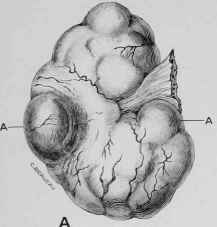
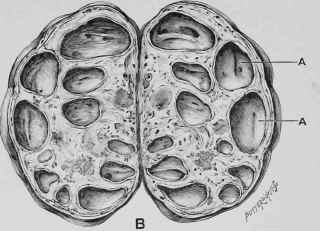
Fig. 238. - Cystic Ovary.
A, The Ovary Entire. a a, Cysts distended with Fluid. B, Ovary in Section, a a, Cysts or Cavities from which Fluid has been removed.
These growths are considered to arise out of some error in the development of the animal in which they occur, and are essentially congenital.
There are no symptoms which will rightly guide us in a diagnosis of these affections. They seldom disturb the general health and rarely occasion death.
Continue to:


My Books

