


Chapter VIII. Intestinal Parasites
Description
This section is from the book "Kennel Secrets: How To Breed, Exhibit And Manage Dogs", by Ashmont. Also available from Amazon: Kennel Secrets: How to Breed, Exhibit and Manage Dogs.
Chapter VIII. Intestinal Parasites
The species of worm with which puppies are most often infested is the Ascaris marginata, called also the Ascaris lumbricoides and round worm, which has a certain superficial resemblance to the common earth-worm, or what boys in the country are accustomed to term angler's worm. This is cylindrical, tapers at both extremities, is slightly pinkish in color, and under the knife, unless the same is very sharp, offers considerable resistance, and when mature cuts like India-rubber. Full growth having been attained it is from two to six inches in length; but the worms found in puppies under four weeks of age usually measure from two to four inches. And they much resemble pieces of cotton twine.
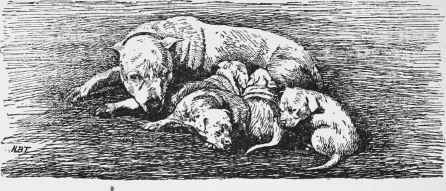
It is not positively known in what ways puppies acquire worms, but it is highly probable that they oftentimes swallow the eggs and larvae directly, also take them up with their food and drink. And certainly very generally the most favorable opportunities for infection are afforded, as will appear from the following: -
The eggs are laid in the intestines of their hosts and expelled with the waste matters, in great numbers and sometimes in great masses, and once in the world they retain their vitality for a long time. But after being expelled it is necessary for these eggs to mature, and conditions favorable for their doing so are found in faecal matter, water or damp places; and this essential stage of development having been completed all is in readiness for the final stage. Now let the eggs be taken up and enter the stomach, and the young worms will burst the shells and speedily mature.
Such, in brief, is the course of infection with this worm; and considering the ease with which it occurs it is not at all surprising that puppies rarely escape it.
A mother harboring the pests is constantly throwing out of her body immense numbers of eggs, and these are deposited about in her kennel and yard, in which, even if the faecal matter is removed daily, some are sure to be left and find here and there, upon the floor, sleeping-bench and ground, the moisture which is necessary for their development. Ignoring the danger of self-reinfection, and assuming that she herself has been treated for worms and all have been expelled, she must inevitably take immense numbers of these eggs up in her coat and carry them with her wherever she goes. Consequently, if removed from her usual quarters to whelp, her new quarters must soon become infested, the eggs being deposited over the floor, on her bedding, etc.
Clearly there is now absolutely nothing to prevent her puppies from ingesting these eggs, even during the first days of life, and swallowing them directly from her breasts, hair, bedding or the floor; and even did infection not occur in this way it must subsequently occur through the food or drinking water, from which it would be simply impossible to keep the eggs, scattered about in such abundance.
Considering the size which worms in puppies have usually attained by the third week, it is evident that infection very generally occurs early in the first week; and such being the case the eggs must be swallowed directly, the same being lodged upon the mother, her bedding, etc.
Now will be seen the reasons for the advice, given in a previous chapter, that the bitch in pup be freed from worms if possible, and she and her quarters be thoroughly cleaned and disinfected a day or two before whelping. And the importance of these measures cannot be too strongly urged, for they will do much to protect puppies from their deadliest foes.
Undeniably cleanliness is the most potent safeguard against infection by worms, and if breeders will drive them out of their mature dogs and afterwards keep their kennels and yards clean, their puppies will be far less frequent victims of them than under less favorable conditions. Furthermore, if their little ones then become infested it will likely be with comparatively small numbers only, which, as a rule, are much less dangerous to life than large numbers.
Efforts to secure cleanliness should include disinfection of the mother's intestinal discharges in the whelping-room and quarters subsequently occupied by her and her little ones, the fact being duly appreciated that she might be harboring worms and not manifest any suspicious signs. And for this purpose quicklime should always be at hand to be dropped on the waste; and that removed, the soiled floor should be washed with boiling water, by which means all ova not touched by the lime would be speedily destroyed.
The symptoms manifested by worms very generally depend not so much upon the mere presence of the lodgers as upon the accompanying and peculiar condition of the mucous membrane of the alimentary canal. And this is one of irritation with an excessive production of mucus; which secretion would seem essential to their development and existence.
When worms are present in large numbers very much if not all of the internal surface of the intestines is, as a rule, irritated and shares in this mucous flux, but when the numbers are small, portions of it only are very greatly affected; and these are in proximity to the pests.
If only a small number of round worms, three or four, perhaps, were present and the victim well on the way to, or had passed, maturity, they would scarcely give rise to very marked symptoms. On the other hand, were he in the first months of life and the number small, even, they would likely prejudice his health; while were they numerous they would surely start a long train of evils which would be very liable to end in death.
One of the earliest evidences of the presence of worms is the appearance, in the intestinal discharges, of mucus, which people are wont to term "slime." This manifested, although at first the bowels may move with normal frequency, or even be less free than usual, with very young puppies certainly it is seldom long before diarrhoea sets in, in consequence of the irritation of the presence of the worms.
Continue to:


My Books

