


Chapter IV. Treatment Of The Mother
Description
This section is from the book "Kennel Secrets: How To Breed, Exhibit And Manage Dogs", by Ashmont. Also available from Amazon: Kennel Secrets: How to Breed, Exhibit and Manage Dogs.
Chapter IV. Treatment Of The Mother
Usually on the day before whelping, but in some cases a little earlier, there occurs a very noticeable change in the bitch, characterized by nervousness, occasional shivering no matter how warm her quarters, dejection - as evident from her listless movements and the grieved and rather despondent expression of her eyes - and a disposition to slink away when at liberty to do so, or a reluctance to come when called if in her kennel. She also manifests unwonted concern about her bedding, which she frequently scratches and tumbles about.
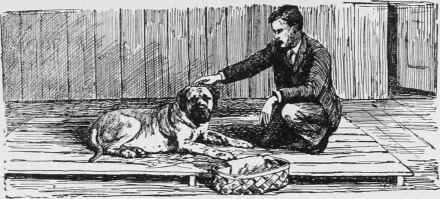
These signs are produced by the first pains of labor, and when they appear the chances are that if all is well the whelping will begin within twenty-four hours.
The disposition to steal away to a retired corner has been accepted by some as a singular impression produced by parturition, and unmistakable evidence that the bitch urgently desires solitude while it is occurring, consequently they reason that she should be isolated and left entirely alone until it is over. But as a matter of fact it is not an instinctive tendency peculiar to this act, for it is often exhibited in other experiences, and especially those of a painful nature. For instance, dogs when suffering from colic are very apt to secrete themselves in out-of-way places and there remain until the pain has subsided, even if the happy event is delayed for many hours.
The reason for this is problematical, but to the careful and experienced observer it must seem as though the disposition was the product of several influences, including primarily the pain and the same fortitude and patience, but in higher degree, which sustain some members of the human family while suffering intensely, and prompt them to suppress as far as possible the outward tokens of the affliction. It would seem to be tinctured also with reproach, - which would not be unnatural where prompt relief was not afforded, - for it is seldom manifested before the pain has been on for several hours, during which period the victims if house pets generally manifest their distress by occasional whinings, appeals to be taken up, etc., and as plainly beg that something be done to alleviate it.
If this assumption is correct - and certainly there is nothing improbable in it - the special rule to leave bitches absolutely or even much to themselves while whelping will not admit of wide application. Nor is its basis, the original instinctive tendency of the bitch, a sound one, for although in her wild state she naturally sought secluded places that her young might remain concealed and out of the way of harm, this fear for their safety must have been greatly lessened by domestication - an influence far more potent than is generally appreciated.
Some bitches, of course, are less deeply impressed by this influence than others, for the reason that from their earliest days they have been confined much to kennels, and in these the old tendency to hide themselves when about to whelp must be still quite strong, yet it can scarcely be strong enough to resist kindness and sympathy when judiciously tendered; while in the majority of their kind that have been humanely treated it must be well-nigh extinct, at least towards those to whom they are accustomed and affectionately inclined.
Bearing upon this point the experience of the writer may be of interest to the average reader. Between his apartments and those of his men there is a large room to which with only rare exceptions his brood animals were transferred a few days before the time for them to whelp, to afford him ample opportunity for observation and proper treatment; and although many have been temporarily quartered there, in not a single instance has he noted a sign indicating that the change was not acceptable; nor where the attendants showed due solicitude was there exhibited the slightest trace of a disposition to slink away.
Hence he naturally holds to the belief that the hard and fast rule to shut in bitches when their whelpings begin, and leave them alone until all is over, is extravagant and inoperative in many instances, while there are good and sufficient reasons why oftentimes they should have the companionship of some one whom they care for if it can be afforded.
One of these reasons hits the pocket, and as it is the' most weighty with many it is given first place. Bitches of large size should be watched during whelping to prevent them from crushing their puppies, for this accident is almost sure to happen unless the mothers are of very small and light bodies. The other pronounced reason has appeared in the foregoing, namely, that bitches will in many instances crave sympathy, and if they do so they should have abundant expressions of it, and be rubbedsoothed and encouraged if such treatment seems grateful to them.
While companionship at this eventful time is advocated, the fact is kept in sight that in some instances bitches urgently desire to be alone, and do better when so; and if this disposition is plainly evident the breeder has really no choice. Yet with bitches of the largest size, at least, he should satisfy himself beyond all doubt that to intrude would be decidedly hazardous for them; and if he exhibits tact he will only rarely find such to be the case, but after a short time the sufferers will give unmistakable evidence that they appreciate his solicitude and are grateful for his attentions.
Of course, there are not a few breeders who give themselves no concern during the whelping period and yet have good success, but probably with scarcely an exception theirs are brood animals of small or medium size, for surely no one could successfully breed the large varieties in this convenient way. And all whose first experience is before them may accept that for mastiffs, St. Bernards and the like, the most painstaking methods of management are required, especially during whelping and with the puppies until long after weaning; consequently they who have but little time to devote to their dogs should choose much smaller varieties.
Continue to:


My Books

