


Chapter II. Varieties Of Animal Foods
Description
This section is from the book "Kennel Secrets: How To Breed, Exhibit And Manage Dogs", by Ashmont. Also available from Amazon: Kennel Secrets: How to Breed, Exhibit and Manage Dogs.
Chapter II. Varieties Of Animal Foods
As stated in the foregoing, puppies while young and growing require in proportion a more generous quantity of animal food for muscle and bone building than they will after they are mature and their structures are complete. This does not mean, however, that they should have a greater proportion of meat than mature dogs, for while yet they are very young, milk will supply them with all the needed materials; but it must prove insufficient after a time, and this comes much sooner with the large than with the small breeds.
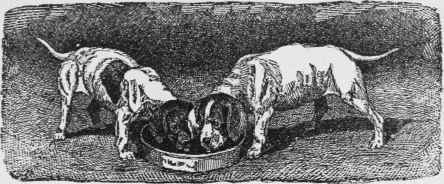
Narrowing the question to meat, as with mature dogs much depends upon existing circumstances. Manifestly a mastiff puppy requires more meat than a pointer, and a Yorkshire still less than the latter. Again, in all litters of reasonable size there are some that need more stimulating food than others, consequently they must be given larger proportions of meat.
In solving this problem the age must of course be considered, also the amount of exercise taken. For instance, in the first three months puppies are much less active than they are during the three following, consequently even were they able properly to digest large quantities of meat soon after the weaning they must not be given them lest their blood and systems be rendered impure thereby. But as they grow older and exercise more, and by this means more quickly eliminate the waste from their bodies, the proportion of meat can be safely increased, although in all instances it must be done gradually, and in some it will be found that the increase required from month to month need not be very great.
It is absolutely impossible, therefore, to fix a rule to govern the proportion of meat for puppies. Considering them as a whole, however, also the quantity of milk that they generally take and the number of meals they have daily, it can safely be accepted that about one-fourth is near right for them after they are three or four months old. But as already intimated it should be larger where they are of the largest breeds, provided always the increase is well borne and the growth more rapid and sturdy under it. On the other hand, the proportion should be less for smaller breeds, many of which will thrive and keep healthy and strong on a diet in which meat only appears occasionally and then in small quantities.
For excess in animal foods there are fixed penalties, and under some conditions of life they are more severe than for those of excess in vegetable foods. While the latter tends to the production of obesity, which in itself is a very serious matter, as with brood bitches, and to diseases especially of the skin, as eczema, the former strikes deeper, and lessens greatly functional activity and leads to an accumulation of impurities within the system.
These effects were well illustrated in two mastiffs, bred by the writer, which a few years ago excited much interest in breeders of their variety, for the reason that they were, as far as known, the largest pair ever raised from the same litter. Both were sold to the same gentleman, the dog puppy in the tenth week and his sister when eight and one-half months old. Their purchaser being an ardent believer in the theory that flesh alone is appropriate food for the dog, fed almost solely on it, and at the tenth month they were each accustomed to eat between four and five pounds daily. Marvellous development was the result, but it was attained at a terrible cost, for the dog died at maturity of what was called a cancerous disease, and his sister followed him in less than a year; she, according to the report of her owner, "breaking out with fearful sores, wasting rapidly and dying after a short illness."
It is reasonable to assume that these mastiffs living lazy, luxurious lives, were destroyed by excess of animal food. And it is a significant fact that the sister, which had been fed on a mixed diet until eight and one-half months of age, yielded to the excess after suffering from it for about the same length of time as her brother.
While considering the evil consequences of excess in animal food attention can properly be directed to the effects of excess in foods properly combined and in correct proportions. Among the most constant of these are disordered digestion, derangements of the bowels, vitiated secretions, torpid action of the vital organs generally, obesity, perverted nutrition, and as concomitants, fatty degeneration and organic diseases. Chronic or permanent distension of the stomach is another disastrous consequence of habitually overloading this organ; which, while it is doubtless frequently acquired after maturity, for obvious reasons far more often occurs during the early months of puppyhood. And it is well to add that once it becomes permanent it can never be overcome; and in after life there is always a tendency to indigestion, nutrition invariably suffers, and as a rule the victims are low in flesh no matter how wisely and generously they are fed.
The question of preparation of animal food deserves a passing notice. Undoubtedly flesh can be rendered more digestible by the means of cooking, and where that is rightly done, all things considered, it can justly be held as best under the usual conditions of life. But when the processes of cooking are faulty and the way in which they :are conducted is indifferent, speaking generally, it is safe to say that meat in its raw state would be better suited to digestion, provided it was in a form which rendered it easily accessible to the digestive fluids - that is, if it was torn or bruised and in small pieces.
Boiling is the method usually resorted to in kennels, it being the most convenient. Aside from the faults of "practice it is open to some quite decided objections, the most pronounced of which is, that it renders the muscular fibre difficult of digestion whether the same is a mass of hard strings, as it were, or finely divided. Soups in which the meat has softened down and " boiled away" are highly nutritious, yet although broken up in minute fragments the muscular fibre is scarcely more digestible than it was while in one mass; moreover these fragments are now enveloped in the gelatine of the meat, - extracted by the long continued high heat, - and this to some extent prevents their being acted on by the digestive fluids.
Continue to:


My Books

