


The Scottish Terrier
Description
This section is from the book "British Dogs At Work", by A. Croxton Smith. Also available from Amazon: British Dogs at Work.
The Scottish Terrier
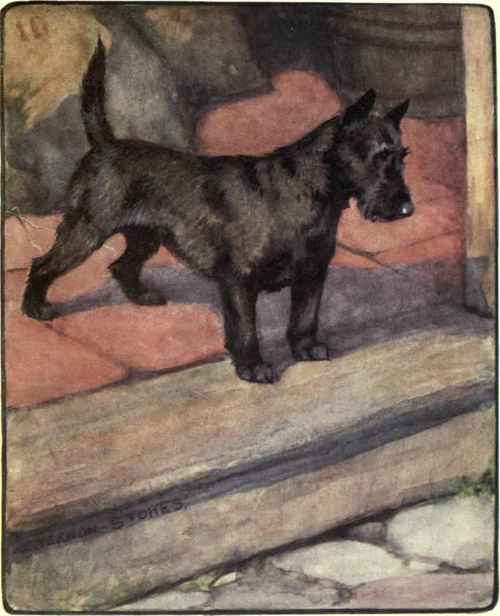
Stout-hearted, quaint of looks, and faithful to a degree, it is not surprising that the Scottish Terrier has won for himself a place in the hearts of all who know him. He is a tough little fellow, and, with increasing popularity on the show bench, he is also of considerable value when his points are good. He has, I believe, a close kinship with the Skye Terrier, although the long profuse coat of the latter lends a marked superficial difference. The Scottie looks the more workmanlike of the two, and he is certainly more suited to the house on account of his short, wiry coat.
His Work
To the English hunting man it sounds rank treason to say it, but Scottie is largely used in the Highlands for turning out a fox while his owner stands by with a gun, but conditions are vastly different. He will also tackle an otter in the water. Indeed he has courage enough for anything.
His Points
In general appearance he is striking, owing to his short legs and alert expression. His head is long, domed, and covered with short wiry hair; muzzle powerful, with level jaws; eyes dark brown or hazel, bright and intelligent; small prick ears, and sharp-pointed; neck short, thick, and powerful, set on sloping shoulders; body moderately long, well ribbed up, and with strong hind-quarters. All four legs short and heavy in bone, the front ones straight, and set on well under the body. The tail is not docked. Coat short, dense, and very hard; best weight about 18 lbs. for the dogs and 16 lbs. for bitches. Colour steel or iron-grey, black or grey brindle, black, sandy, or wheaten.
Continue to:


My Books

