


Chapter XXXV. Cat Feeding
Description
This section is from the book "Everybody's Cat Book", by Dorothy Bevill Champion. See also: Your Cat: Simple New Secrets to a Longer, Stronger Life.
Chapter XXXV. Cat Feeding
More attention should be paid to the diet of an animal than any other part of its care.
There can be no success if your cat is not properly fed.
It must be clearly understood, if you are starting to breed pedigreed animals, and many of them, they cannot be fed as you would one pet cat, which has its entire liberty and does not breed. Breeding from animals taxes their strength to the utmost, and they must be fed in proportion, or they will become weakly and contract all kinds of diseases, especially skin diseases.
Cats should be fed strictly on a meat diet; no cereals, such as oatmeal, rice, etc.; no potatoes, and, lastly, not a drop of cow's milk, whether it is boiled or not, even should you keep a cow. We had a Jersey cow for some years, but not a cat in the place was allowed milk; in fact, few of them would drink milk after being fed on meat.
Milk feeding causes chronic dysentery, and a cat or kitten so fed is never free from worms. They are also subject to skin trouble, from poverty of blood; in fact, a milk-fed cat is always in a semi-starved condition.
Of course, I know cats have been fed on milk for years, and in many cases they live on it; but the same cat could be changed on to a meat diet with marked improvement.
On the other hand, try changing a meat-fed cat to a milk and cereal diet. The result will be disastrous, the cat soon being reduced to a wreck of its former self.
Meat has been proved by a majority of successful breeders to be the only proper diet for the fancy cat. Raw beef is best, preferably minced, with bones given daily or at frequent intervals, and fresh green grass always accessible.
The quantity given must entirely depend on circumstances. For instance, a cat in the summer months, if not being bred from, needs only two small meat meals a day, or as much as it will eat up quickly. Breeding cats need large meals night and morning, about half a pound of meat each during the day, and in the autumn, about September, let them have all they can eat twice a day, to fatten them up and grow a coat for the winter, giving less about January or February, unless they are kept where it is excessively cold. About March, a pinch of phosphate of soda may be given once a day for a week or two, to cool the blood and prevent the cat shedding its hair too quickly.
Cats "in kitten" should have about six ounces of lean raw meat twice a day, moistened with a little lime-water.
For those keeping a number, I would advise buying a full cut shin of beef or several pounds of neck. Have this cut up and minced; then, in addition to this, a lamb's or sheep's haslet may be cut up and cooked, using only the best parts. Have this minced when cold, and use the gravy to mix it together with the raw meat. A little green vegetable may be added. Always use three parts raw meat to one of any substitute. Never use bread, but dog-cakes broken up and soaked in cold water for twelve hours, then put through the mincer and mixed with three parts raw meat, is also a good diet, as the biscuit is far more nourishing than bread or any other cereal.

Champion Petie K.
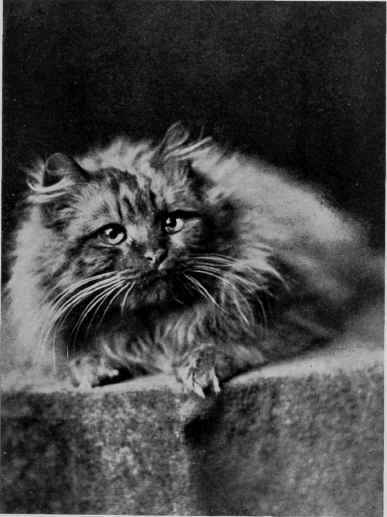
Champion Lord Kew Tangerine.
Bear in mind that this mixed diet should only be fed to cats which are not breeding, such as neuters, young cats, or old cats which have given up breeding, all kittens, cats "in kitten," or nursing kittens, and all stud cats, should be fed on a pure meat diet.
Fresh lamb or mutton, boned and minced, fed raw, agrees very well with cats. The fat cannot be removed, but when fed raw it does not disagree with them; but lamb or beef should on no account be fed when boiled; lamb becomes too rich, and cooked fat upsets a cat very quickly; the beef becomes hard and indigestible.
Beef hearts and pigs' livers should never be given, and cooked beef liver very seldom; no liver should be fed raw.
I have often wondered how fanciers could write to the cat papers and advocate a mixed cereal and milk diet, with an occasional meat meal. They seem to convince themselves that it is correct, but if you were to see their cats, as I have done, you would notice the poor animals are sorely in want of a good meat diet; and when shown at the winter shows, they are conspicuous for want of coat; they look as if they had forgotten all about winter, and had retained their summer raiment. The fact is, they have only beeen provided with enough food to keep them alive, and have not had enough nutritious food to grow their coats.
When you observe well-bred, long-haired cats at our winter shows, almost hairless, you can draw your own conclusions; either they have been hopelessly underfed or bred from too often; in some cases both.
It is far more profitable to keep just one or two cats and feed them properly than to keep a number and feed them badly.
Poor diet is the root of most "ills."
Continue to:


My Books

