


Wild Cat Species
Description
This section is from the book "The Book Of The Cat", by Frances Simpson. Also available from Amazon: The Book Of The Cat.
Wild Cat Species
We cannot leave the American exhibition cats without saying a word upon the wild species, some of which find their way into the show rooms on more than one or two occasions. Of course, the cougar or mountain lion - our biggest species - is out of court on account of his size; but still, if history is to be believed, this fine animal was never injurious to man, and has not been known in recent times to attack man, though he is fitted by size and strength to do a great deal of damage. The next in order is the lynx, and though this animal is pictured as very fierce, there is as much evidence to show, in other ways, that if taken young and domesticated, the lynx is amenable to reason and is very intelligent, full of humour, and not afflicted with excessive nervousness. I have seen specimens exhibited, and one in particular that was the constant playmate of a little child ; and this cat spent four days in a show playing most of the time with all the children that came along, and was the coolest and most unconcerned cat in the hall.
Evidently the lynx shares the great brain power of the cat family which those who are well acquainted with cats are willing to concede to them, added to a calmness of temperament foreign to some of our so-called domesticated breeds that ought to have inherited by now, perhaps, more savoir faire under show conditions.
When on a ranch in the wilds with a few cats and dogs, where quarters were limited, I could never see that there was a natural antipathy between cats and dogs, for the bitches would rear kittens and vice versa, and the friendship was great between them - so much so that they would play together for hours, and there was no danger in leaving dogs and cats together, shut up in the house, when we were absent. In later times I have had twenty cats or more running around with as many dogs, and never had a cat killed, and only two or three occasions when any trouble started. The supposed antipathy between cat and dog seems to be an acquired taste in a certain measure, and personally I do not believe in the antipathy being natural or a fact, for the two will live together in peace if not set upon each other by man.
From a few observations I believe the lynx is capable of domestication ; of course, his size precludes his being numerous, but in this variety there are possibilities as yet not sufficiently tried out.
Of other cats, in contradistinction to this, we may mention that beautiful cat the ocelot. This cat is fairly plentiful, and is not very difficult to obtain when young; and though they are so handsome and can be reared and left to run about the house till a year old, as they arrive at maturity they become what the ladies call "impossible." The ocelot with increasing age grows hopelessly savage, and will kill anything put in his cage that he is capable of handling, and even to his keeper he is a problem. This evidence is not hearsay, but is from one who tried for a long time to do something with these beautiful animals. They are, when in condition, one of our handsomest specimens of the cat tribe.

Mrs. Clarence Houck's Cattery, "Orchard Ridge," New Scotland, N.Y.
One of the most fascinating little cats I ever judged was a little Marguay cat from Brazil, exhibited by the Zoological Society of Chicago, and though quite small and delicate-looking, it seemed perfectly healthy, and, as in the case of the lynx, was as tame and affectionate as possible, and seemed delighted to be noticed and handled. I cannot help thinking that if obtainable and kept pure this would make one of the most beautiful of exhibition cats. Small, of a reddish-brown colour, and clearly spotted all over, with beautifully shaped and small ears, which are black-and-white, this cat is gentle, sweet, sizeable, and possible as a pet. I have never seen it excelled by anything among the cat tribe; and having handled this cat a good many times during the show, I may say it was one of the tamest and best-natured cats I ever came across in the show-room, and certainly the most beautiful short-haired cat possible to imagine.
On one or two occasions we have had Australian cats exhibited, and they were funny little beasts, sitting up like a squirrel, and with much the same shape of head. When genuine they are most quaint, but do not seem to live long here. A very clever fake was carried out with these cats at some of the early shows - or, rather, I should not say with these cats, but an imitation of these cats. When the supply became limited, someone became clever enough to augment the number by shaving the long and ragged native short-hairs, and so well was it done that they not only won prizes, but on one occasion one was bought by a judge after winning, when to his purchaser's disgust a month or two later he turned out to be an ordinary yellow torn with his coat on!
The Australian cat fell into disfavour after a few of these experiences, and it has not been possible to resuscitate him.
We often hear of the Pampas cat of South America being in certain catteries, but so far at the shows none have been produced, and I am inclined to think these also are of the impossible brigade on account of their savage disposition. It is a pity that some enterprising fancier does not try to tame these wild species.
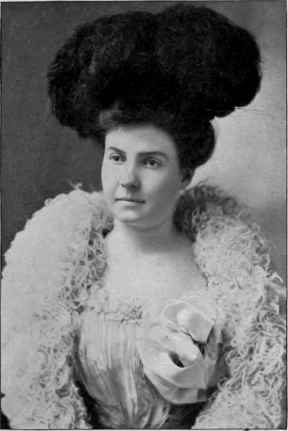
Mrs. Charles A. White. An American Cat Fancier (Photo: Bolls, Chicago).
Continue to:


My Books

