


Some Foreign Cats. Continued
Description
This section is from the book "The Book Of The Cat", by Frances Simpson. Also available from Amazon: The Book Of The Cat.
Some Foreign Cats. Continued
We can only add, whilst deeply regretting that Mr. Shinick did not mate his cats, the earnest hope that we may hear that he has discovered the existence of other specimens. Should it prove that a parcel of street curs are responsible for this curious variety becoming extinct, even such confirmed dog lovers as ourselves are almost tempted to acquiesce in a universal and everlasting muzzling order ! It is to be regretted that no information is given as to whether the dentition of these cats was abnormal and imperfect, as is the case with the Mexican hairless dogs.
Very curious and handsome is the Indian cat "Indischer Furst," exhibited by Mrs. H. C. Brooke. His most striking peculiarities are the length and slenderness of his limbs, the extreme shortness of his coat, and his thin and tapering tail, which reminds the observer of that of a pointer. His ears are small, but as a kitten they were of enormous size, and with his long and pointed head gave him a most weird appearance. The voice of this cat is very variable, and far more resembles the raucous call of the Siamese than the voice of any European cat.
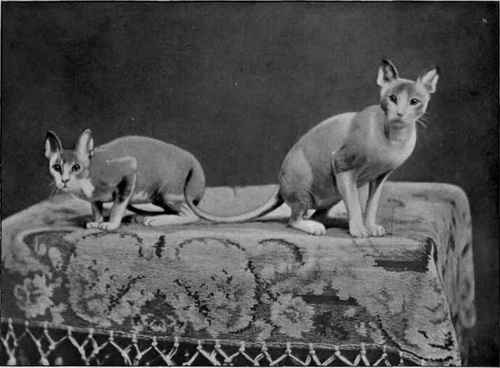
Mexican Hairless Cats
This cat has had a very adventurous existence. He, with his litter sister, was originally stolen from a hotel in Bombay by an English sailor. On the way home he twice fell overboard, but, more fortunate than his companion, was safely rescued. He also suffered shipwreck in the Sobraon on Yung Yung Island. On arriving nearer home he disappeared, and was only after several days' absence discovered in the bowels of the ship, as black as the coal amongst which he had been sojourning. His last exploit was to fall in the docks, after which the sailor handed him over to a shoemaker at Leytonstone, where he was discovered by his present owner. After he had twice escaped from bondage and astonished the natives of that place by perambulating the housetops, lamenting in the tones of a lost soul, his owner arrived at the conclusion that he had no convenience for restraining him, and at last yielded to persuasion, and handed him over to his present proprietors for consideration of sundry gold coins of the realm and a kitten with seven toes on each foot.

African Cat (Photo: E. Landor, Ealing.)
It is a very remarkable thing that the Asiatic cats are so subject to abnormal formations of the tail. The Siamese cats, as is well known, very frequently possess kinked tails. In Burma also cats are found - some tail-less, some with crooked or twisted stumps. These cats, when spotted, are very striking ; when of an ordinary colour they simply recall an indifferent Manx.
Japan also possesses tail-less cats ; but those with ordinary caudal appendages also occur, and are probably the most numerous. There is said to be a variety of Chinese cat which is remarkable for its pendent ears. We have never been able to ascertain anything definite with regard to this variety. Some years back a class was provided for them at a certain Continental cat show, and we went across in the hope of seeing and, if possible, acquiring some specimens; but, alas, the class was empty ! We have seen a stuffed specimen in a Continental museum, which was a half-long-haired cat, the ears being pendent down the sides of the head instead of erect; but do not attach much value to this.
We have seen specimens of a very tiny domestic cat, full-grown individuals of which weigh only about three pounds. Those we saw came from South America.
A cat called the Mombassa cat, from the East of Africa, is said to have a short coat of a wiry texture. There are, of course, no cats indigenous to Australia. An American writer gives it as his opinion that a certain strain of Australian cats is derived from imported Siamese cats. A specimen we possessed last year, which was born on a ship during the passage from Australia, and which exactly resembled its dam, certainly had every appearance of being of Eastern origin. It had the marten-shaped head, and a triple kink in the tail ; its voice also resembled that of the Siamese. In colour it was grey, with darker spots.

Abyssinian And Indian Cats (From a Painting by W. Luker, Jun.)
A very taking variety is the Abyssinian. A good specimen should very strongly resemble what one might well expect the Egyptian cat to become after generations of domestication. Since the death of "Sedgemere Bottle" and "Sedgemere Peaty" there have been no cats penned of such superlative merit as were these two specimens. The photograph of" Sedgemere Peaty" which we give hardly does justice to the cat. The colour of an Abyssinian should be a sort of reddish-fawn, each individual hair being "ticked" like that of a wild rabbit - hence the popular name of "bunny cat." The great difficulty in breeding these cats is their tendency to come too dark and too heavily striped on the limbs; the face should be rather long, the tail short and thick, and the ears large. These points are well shown by "Little Bunny Teedle Tit," first in the Abyssinian class at the 1902 Crystal Palace cat show, though in colour she was not the best penned. The Abyssinian should not be a large, coarse cat. A small cat of delicate colouring and with the above-mentioned body properties is by far to be preferred to the large, coarse, dark specimens one sees winning under some all-round judges, merely because of their size.
More than any other varieties have the foreign cats suffered from the negligence of show committees and the awful judging of all-round judges, plus the equally awful reports furnished by all-round reporters! At the best, knowledge of the different varieties of foreign cats is absolutely in its infancy. It should be the aim of large shows to provide, whenever possible, judges for these interesting strangers who do really take some interest in them. I am bound to say that of late years the National Cat Club has done its best to meet the wishes of owners in this respect, and with gratifying results, as witness the good classes at the Crystal Palace show, where there were no fewer than eleven Abyssinians penned - a record number!
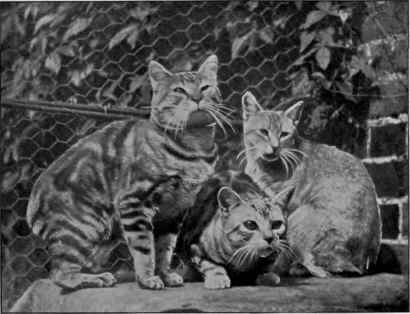
Manx And Abyssinian ("Sedgemere Peaty" On The Right) (Photo: A. R. Dresser.)
The Cat Club, on the other hand, has persistently neglected them, having on almost every occasion handed them over to some all-round judge who knows little and cares less about them, with the natural result that exhibitors are disgusted. Take, for instance, the last show, when a very dark, almost sooty Abyssinian was placed above a very fair specimen merely because the latter had about a dozen white hairs on its throat! The value of the winner may be gauged from the fact that its owner, a lady well known in the cat world, expressed her intention of having him neutered and keeping him merely as a pet. The same judge, in dividing the prizes amongst the Manx cats, appeared to think the colour of the throat of far more importance than the shape of the hindquarters in this section. Again, of what value does the reporter flatter himself his writings can be when we read in a so-called critique of a spotted Geoffroy's cat and of an ocelot that they are "pretty tiger-marked specimens"? We wonder if the gentleman ever saw a tiger.
There is much that is fascinating - much, nay almost all - to learn, the most beautiful colours and arrangements of- markings to be studied, by those who will devote their attention to foreign cats. To the search for something new we owe the beautiful Siamese. Will no one pay some attention to the other varieties of the feline tribe from distant lands? They are well worth it, and the addition of more foreign cats at our shows would be interesting and instructive. H. C. Brooke.

Geoffroy's Wild Cat (Photo : Cassell & Company, Limited.)
Continue to:


My Books

