


Silver Tabbies. Part 3
Description
This section is from the book "The Book Of The Cat", by Frances Simpson. Also available from Amazon: The Book Of The Cat.
Silver Tabbies. Part 3
"Competent judges agree that to breed regular, symmetrical, and well-coloured markings is no easy task, for contrast is the grand point in a silver tabby. His ground coat from tip to tail should be pure pale white silver. On this light silver ground-work lie the most beautiful even dark mottlings, dark to the point of blackness. These markings are most difficult to describe. A dark stripe runs the whole length of the spine. Then comes a light stripe on either side, then two more dark stripes, but these are broken just behind the shoulder by a transverse bar of light silver, and widen on the shoulder into considerable sized patches. The markings on the sides are not stripes, but patches, elliptical in shape, generally three in number, and partially encircled by dark stripes. The shoulder is particularly heavily barred and striped, as are also the hind quarters. The legs are barred throughout their length, the face should be dark, with dark tufts, and the back part of the hind legs from the knee downwards is black, as in a Southdown sheep. "The head is most beautifully pencilled, the cheeks possess double or treble swirls, the eyes are outlined by dark rims; on the forehead the lines form a complete triangle, which is repeated at the nape of the neck.
The chest is encircled with a perfect dark ring, called the' Lord Mayor's chain,' but this is concealed when the large light frill is in full beauty, as is also the neck triangle. The whiskers often contain all the different shades of colour found in the coat. The ear tufts should be long and light. The tail is generally ringed from trunk to tip, but this is not noticeable after kittenhood, owing to the great length of the hair. Also the hair to the root is much darker in colour on the tail than on the body.
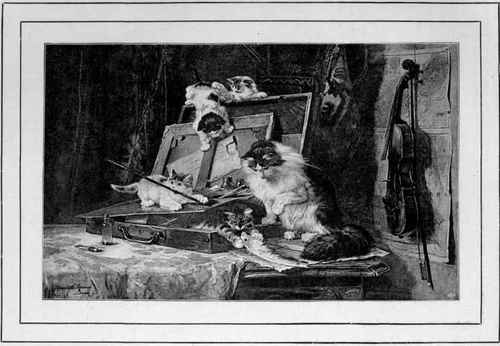
In The Studio (From a Painting by Madame Ronner.)
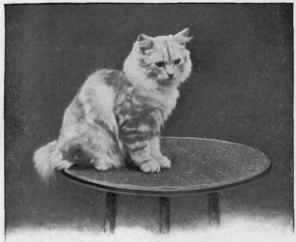
Miss Copes "Starlet."
"The correct colour for the eyes of a silver tabby is neither green, orange, nor yellow, but hazel - a deep nut-brown. This shade of eye is very difficult to obtain, and it fades with age; but once seen, its beauty and suitability to the colouring of the cat will never be denied. Many of the most noted prize-winners have not possessed this coveted hazel eye. The nose is by preference dark, but this, so far, has not been considered as a point.
"Not only evenness and regularity of markings go to the making of a good tabby, but sharpness and depth of colour in the dark parts, and clearness of colour in the light parts. A great deal has been said of late regarding the depth of the black markings ; but it is quite as necessary to insist on the purity of the silver tone. No suspicion of brown must be tolerated, neither any blue nor grey tone.
"There is no question that, as a tabby, a long-haired cat is handicapped by his length of coat. There are some people who would rob him of his crowning glory in order that his beautiful striping may the better appear. But surely it were better for them to confine themselves to short-haired cats if they cannot appreciate the marvel of long-haired tabby markings. For marvellous they truly are, when we consider that the dark marks are only formed by tips to the hair of some quarter of an inch in length. When the coat is quite short these tips are massed together, and the blackness is, so to speak, concentrated. When the hair is at its full length - of from two to four inches - it can be readily understood that the long floating locks mix and mingle with the paler coat, and some distinctness of marking is lost. The massive frill and the long light shoulder tufts give the cat a very pale frontage ; and if he be placed in a show-pen side by side with a cat whose coat is just coming, whose marks show up, in all probability he will take a second place. No stroking, blowing of the coat, or other device will show off a tabby cat. He must be made to get up and walk.
Then the long coat falls apart, the spine lines reveal themselves, the side patches fall into place, and bars, stripes, swirls, and rings all are to be seen. Even then you will not see them all at once, but as he moves and turns one by one the points will show themselves. As a show cat, a tabby is not a success, for his period of perfect beauty is exceedingly short. When he proposes to moult he changes colour, and if you are unwise enough to exhibit him at this stage ominous whispers of 'Brown tabby blood' will pass from mouth to mouth. For a thorough good rusty brown shade, commend me to a moulting silver tabby. Then a little later he completely loses his side markings, and you must wait until the new coat makes its appearance before you can venture him in the show pen. In the first beauty of that new coat, when the hair is about an inch long, he is a dream of colour contrast, and somehow suggests such ineffable cleanliness!
" How to breed silver tabbies is a moot point. One thing is certain, that if we expect whole litters of well-marked kittens we shall be grievously disappointed. Personally, we have had the best results from pairing two marked cats slightly related and of good silver pedigrees. A smoke of silver origin is another good cross, but the sire should always be a tabby. The blacker the kittens are at birth the better. There is no sign of light undercoat, but generally narrow pencillings of silver are to be seen, and face and paws are fairly light. The kittens which at birth show contrast of dark and light rarely turn out good tabbies. The markings, as a rule, become too faint. At a month old the light markings should widen and develop, and at three months old the full beauty will be seen. Before the change to cat coat, many of the kittens become more shaded than marked, and up to the sixth or eighth month there is always a possibility of their proving disappointing. If, however, after this age the markings return, harden, and develop, they will endure for ever, except during periods of moulting. In extreme old age both the purity of colouring and distinctness of markings are lost. Exposure to the sun considerably injures the colour of the silver tabby cats, giving them a brown tinge.
Continue to:


My Books

