


Rearing Of Kittens. Part 3
Description
This section is from the book "The Book Of The Cat", by Frances Simpson. Also available from Amazon: The Book Of The Cat.
Rearing Of Kittens. Part 3
It is only of comparatively recent date that any serious attention has been given to the successful breeding of Persian kittens.
A demand has arisen for animals that approach perfection, according to a recognised standard of points, and it may not be unprofitable to devote a few pages to the consideration of how these can be best obtained.
Formerly a long-haired cat was not much thought of unless he really deserved his name, but nowadays coat is rather at a discount on the show bench.
Points, points, points - colour of eyes, colour of coat, shape, expression, and what not these are all considered first, and length and beauty of coat are rather apt to be overlooked. The amateur cat lover should provide himself with a female cat or kitten of fine health and luxuriant coat, and treat it precisely like any other "well done by" domestic pussy. Probably by the time she is twelve months old she will have insisted on matrimony. This is worth a little consideration and trouble, but if the choice lies between a healthy, hardy longhaired torn at large in your own neighbourhood and a pedigreed prisoner at a distance, I should recommend the local monsieur.

A Litter Of Eight, Belonging To Miss Savery (Photo: H. Warschawski,St. Leonards-on-Sea.)
What you want is physique and a fine appearance, and you are more likely to get them in this way.
Many owners of Persians have been quite content to rear saleable kittens of average merit, and trust for their show reputation to fine animals bought from others.
To encourage breeders special prizes are offered at shows to those who win a first prize with a cat whose mother was in the exhibitor's possession at the time of the kitten's birth. They are very handsome trophies, and have to be won four times before becoming the property of the exhibitor.
Over against the mistaken motto of "Haphazard" we must place the password of "Selection" if we would become successful breeders. Selection - clever, thoughtful, painstaking selection - lies beneath all real success. I am not denying that excellent results are obtained occasionally by accident, but these happy flukes want following up if any permanent good is to be effected.
Having a queen of a given colour, you should, as a rule, mate her only with a cat of the same colouring, and be especially careful not to cross self-colours with tabbies.
Now selection, as too often understood, means just this : A male cat makes a great sensation at a show and wins many prizes. He is the right colour, therefore to him you will send your queen. What can be simpler ? Why this fuss about the difficulty of breeding ?
But you are a novice, and know nothing of the value of the pedigree owned by the winning monsieur. It is not so much he himself as his inherited tendencies you have to consider, for assuredly they will reappear in his children.
An old hand will tell you, "Yes, a grand head, but where he got it from is a miracle, with such parents" ; or, "Colour? Yes, first-rate, but he was the only one clear from sandy in the litter." Well, what can a bewildered novice do? Remember, you have to try to cap each of your queen's defects with a corresponding virtue in her mate. If she is snipey in face, make head a chief point ; if she fails in colour, lay great stress on colour; and so on. My advice is, do not send her to a new star who has but just arisen in the sky of the cat world until you know a little more about your business. Mark your catalogue at shows. Study the cats and kittens whose points please you and who are filling the prize lists, and then notice their sire's name. When you find the same name repeated again and again, and always attached to animals of consistent merit, you will not do far wrong to choose the owner for your queen's mate.
But after having exercised all possible care in the selection of a male cat, we must not expect the litter of kittens to be perfection. All breeders know that there is, as a rule, one kitten in each litter which far surpasses its fellows in beauty.
Perhaps one will possess the type of head you so covet, but the colour is inferior. Another has colour or markings to perfection, whilst the head is poor Well, then, they must be mated with an eye to remedying these defects, and a near relative possessing these strong points will be likely to prove the most successful cross; for in-breeding - careful, cautious, and judicious - is another secret of the successful breeder. But one word of caution to the novice : Never be persuaded to breed from an unhealthy animal, be his or her points what they may, and never allow your queens to mate when thoroughly debilitated and out of health; for this lies at the bottom of the difficulty experienced in carrying out the next point we have to consider - i.e. the successful rearing of kittens. If cat fanciers could learn this lesson, we should hear far less of infant mortality.

"Star Of The Spheres" And "Son Of Roy." Bred by Miss E. A. Chamberlayne. (Photo : Russell & Sons, Baker Street.)
For the ordinary mode of kitten rearing it is essential to have proper out-door quarters, and, if possible, quarters isolated from each other. There is nothing more suitable than the portable houses so readily obtained ; but these must be on a dry foundation.
Sunshine, fresh air, and wholesome food are the essentials of a kitten nursery. Moreover, there must never be many young things kept together. Otherwise, some unlucky day you will find a sad-faced kitten looking down its nose, and in two or three days more your whole tribe will be down with distemper and your hopes for the year shattered.
I know it sounds brutal, but I cannot refrain from saying that sentiment is the ruin of successful kitten rearing. Some tiny morsel develops a skin trouble, has chronic diarrhoea, bad eyes or snuffles, and we tenderly nurse it for many weary weeks and perhaps save it.
A victory? Yes, if the morsel were a gem of great value, one of the "surprise babies" in colour or shape that now and again visit every cattery, it may have been worth paying the cost. For pay we shall have to, make no doubt of that. Your kitten nursery will never be quite so healthy again, and in spite of all precautions yon will very probably carry sickness to your other stock. I would never breed from unhealthy animals, and I would at once destroy a very sick kitten of tender age.
Lethal boxes rob the act of inhumanity, and you will probably have one little tombstone to erect instead of a dozen !
One great feature of success is the boarding-out system. Any woman really fond of cats who will take a kitten into the bosom of her family and rear it is a perfect boon. Of course, she must be well paid, but if she is successful you can afford to be liberal.
In these cases it is better only to put out your choice specimens that you wish to attain some age before sale or to keep for stock. The others should be sold off at about eight to ten weeks old at moderate prices.
Far more of the trouble with kittens comes from defective digestion than from any other cause, and I suspect we frequently overload their little interiors. When nature makes the small cat turn away from its dinner, we fall into a panic and pour beef essence down its throat. Probably a short fast was all that was required, and it is a mistake to force food until some hours have elapsed. In fact, healthy surroundings and common-sense treatment are the main secrets of successful kitten rearing.

The "Foster-Mother." (Photo: H. Glacier, Longsight.)
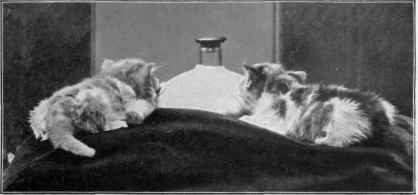
The "Poster-Mother" In Action (Photo : H Glacier, Longsight.)
Continue to:


My Books

