


Management Of Cat Shows. Part 4
Description
This section is from the book "The Book Of The Cat", by Frances Simpson. Also available from Amazon: The Book Of The Cat.
Management Of Cat Shows. Part 4
In order to facilitate the work of the judges, it is well to have their books carefully and clearly arranged, and this especially applies to the list of special awards. I instituted a plan at Westminster Show, in 1901, which gave great satisfaction, but which entailed a lot of extra work for the secretary. I am sure, however, this special arrangement lightened the labours of the judges, and hastened the appearance of the special prize cards on the pens. I had separate books for the special awards, and carefully cut out of the schedules the prizes pertaining to each judge. Thus, if Mr. A. had black, white, and blue long-haired classes, every challenge medal and special offered for these cats I arranged in order on one side of the page, with the numbering as it appeared with them in the schedule. So in the left-hand page would be, say, "Special No. 10, for best long-haired black," and on the right-hand page " Awarded to No....., " leaving a blank for the judge to fill in the number of the winner. Any prizes that had to be awarded in conjunction with other judges, such as for best long-haired cat in the show, I made a note of to this effect.
Let me add that I gummed the printed portions relating to the prizes, cut from the schedule, into the judging books, so the judges needed neither schedule nor catalogue to refer to. In preparing judges' books it is very helpful to place male and female (M. and F.) after each catalogue number in the mixed kitten classes, to avoid reference for the special awards; and this should also be done in the catalogue itself, as very often the name of the kitten does not indicate the sex, and would-be purchasers are obliged to make inquiries.
I am always an advocate for having selling classes for cats and kittens at shows, where the price should be limited to £5 5s. in the long-haired classes, and £3 3s. in the short-haired classes. It would be an assistance if someone who understood cats, and was also a good salesman or saleswoman, undertook to preside over the selling classes. The 10 per cent. commission deducted by the show authorities is a material help, and often a little pressure and persuasion, combined with useful information, will decide a wavering purchaser. A class I should like to see introduced into our shows is one for kittens bred by exhibitors. I am of opinion that more encouragement should be given to fanciers to keep the best of their litters for exhibition. Lady Marcus Beresford had the happy inspiration of starting breeders' cups for competition at Cat Club shows, and special prizes are often given for the best kitten bred by exhibitors. But these are tiresome awards for a judge to make; he is obliged to make inquiries from someone with a catalogue, and even this reference will not always suffice.
It is always pleasant to win prizes, but an additional pride would naturally be felt if, in a large class of kittens bred by well-known exhibitors, the son or daughter of our own breeding should be awarded first and special.

Judging In The Ring At The Crystal Palace (Photo: Russell & Sons, Crystal Palace. )
With respect to a ring class, which is often held at some of the National Cat Club shows, I cannot say that it is very interesting to see a collection of toms, females, and neuters, long- and short-haired, being dragged along by their anxious owners, whilst the puzzled judges try hard to decide which of the motley and mixed assembly is most worthy of honours. I think that for a ring class neuters alone should be eligible, or at any rate until we have trained our young cats to behave properly on a lead. There need be no necessity for the neuters to be entered and penned in the show, but they could be charged a higher fee for the ring class; and I believe that many owners of neuters would not object to their precious pets being on exhibition for ten or twenty minutes, led by themselves into the ring, but who will not let them be cramped up in a pen for two days. Neuters are always at a disadvantage in the show pen - they are generally too large and too lazy to be properly seen, and a ring class for these specimens would be a very attractive feature at our cat shows. A row of chairs should be placed round, and sixpence a seat charged. It is quite absurd to mix up the sexes, and dangerous to allow torn cats to come within fighting distance of each other.
At a recent show great excitement was caused in the ring by the sudden attack of one famous stud cat on another, and it was lucky that nothing worse than a torn and bleeding ear was the result of this onslaught. Another class I should like to see at some of our large shows, and certainly at the summer N. C. C. Show, is a class for stud cats, which should be judged quite irrespective of coat, and special attention directed to form of limb, size of head, and massive build in awarding the prizes. This might not be an attractive class, but it would be an instructive one, and give the veterans a chance of proving of what stuff they are made. A young untried male will often take all the honours in his class, and the stud cat of a busy season is forced to take a back place, probably on account of services rendered. Anyhow, this idea might be carried out as regards the two largest classes - namely, those for silver and blue Persians. In former days there used to be classes at some of the shows in which the cats were judged by weight, but these have wisely been done away with.
The question of open judging at cat shows has frequently been discussed in catty circles, and several fanciers have given their opinions on this subject.
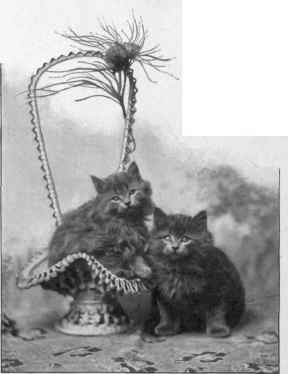
Miss Kirkpatrick's Blue Kittens (Photo: E. Landor, Ealing. )
Mrs. Neate, a well-known fancier, writes thus in Fur and Feather: - "It would indeed be a step in the right direction if cat shows were run on (as far as possible) the same lines as dog shows. Much of the absurd mystery that at present envelops our cat shows would vanish if exhibitors were permitted to be present during the judging, and I feel sure that the majority of cat fanciers would not be so wanting in etiquette and good taste as to hinder the judges or any of the officials in discharge of their onerous duties." No doubt there is much truth in these remarks; but, at the same time, I do not think fanciers take sufficiently into consideration the very timid, shrinking nature of the cat when they advocate open judging. It is often most difficult for a judge to properly examine a cat. even when he or she is quietly going round giving the awards; it would be still more trying to man and beast if a collection of strangers were pressing forward on all sides.
Continue to:


My Books

