


Management Of Cat Shows. Part 2
Description
This section is from the book "The Book Of The Cat", by Frances Simpson. Also available from Amazon: The Book Of The Cat.
Management Of Cat Shows. Part 2
The names of the judges, with their respective classes, should be clearly set forth, and it should be mentioned whether classes will or will not be amalgamated or cancelled. A few advertisements of stud cats and trade notices should be obtained, as this means grist to the mill and helps to pay for the printing of the schedules and catalogues.

Richmond Cat Show: The King Class. (Photo: Cassell & Company, Limited. )
The question of classification is an all-important one, and needs the consideration of a careful show committee, well versed in the ways of cats and of fanciers. A list of the classification used by one or two big cat clubs has been given. Of course, at smaller shows it is often impossible to give separate classes for several breeds or to divide the sexes; but my remarks in this chapter will refer to the customs and arrangements of large shows, such as those held by the National Cat Club at the Crystal Palace, and the Cat Club at Westminster. I do not think it is good policy on the part of a show committee or management to amalgamate classes. It is much better to advertise in schedules that when entries are fewer than, say, four or five, then the judges are empowered to withhold any of the prizes; or, again, in the case of a very small class, half prize money might be awarded.
Having decided on the classification, and given as liberal and attractive a one as 1 possible and practicable, it is well to consider the number of schedules likely to be required, and then start addressing the wrappers. In each schedule must be inserted two or three entry and registration forms. The entry forms. with fees, are returned to the secretary, and the registration forms to the person who keeps the register of the club holding the show. And here I would remark on the mistake it is to have two registers for cats. It is very confusing for exhibitors, and a double expense, as the National Cat Club and the Cat Club each charge a shilling. Then, again, as the National Cat Club has recently passed a rule disqualifying all cats exhibited at Cat Club shows, the confusion is worse confounded. Some fanciers having large catteries divide their exhibits and send to both National Cat Club and Cat Club shows; but this new registration rule falls heavily on cat fanciers who are keen to exhibit their specimens and anxious for the pleasure of obtaining prizes, and desire to profit by showing their stud cats or having an opportunity of disposing of their stock.
The National Cat Club shows since the passing of this rule have suffered considerably, both from lack of entries and by the absence of some of the fine champion cats that, having been exhibited at the Cat Club show in January, were thus debarred from appearing at the Botanic Gardens and Crystal Palace shows. How much simpler and better it would be if both clubs could and would agree to have one register kept by an independent person, not necessarily a catty individual, and that the fees should form the salary of such a person. A small fee might be charged when reference was desired by fanciers as to the pedigree of any cats. If the secretary7 of a show happens to be acquainted with the members of the cat fancy, he will be able to use his discretion as to the number of entry and registration forms needed. In some cases, where he is sending to a well-known breeder and possessor of a large cattery, more numerous forms will be required. Schedules should be sent out quite a clear month in advance, and the entries should close about ten days before the date of the show. The secretary will have a book in which he will note down each entry as it is received, placing it under the correct class heading, and, of course, these can only be numbered up when entries close.
The entry forms should be filed and kept for reference. Then comes the work of arranging and writing the labels, and placing these with the tallies, entrance tickets, and removal orders in envelopes and addressing them to the exhibitors. These should be posted four clear days before the show.
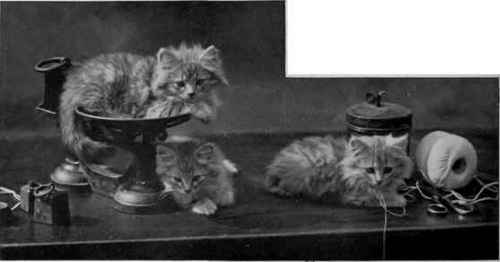
"Minding Shop. " (Photo: C. Reid, Wishaw. )
During this time the secretary will be able to compile the catalogue for the printer, and arrange to have an instalment of copies the night before the opening day of the show, also to draw up the judges' books. Letters should be written to the judges and veterinary surgeons acquainting them with the hour at which they are desired to present themselves at the hall, and a complimentary pass ticket should be enclosed. A pass should also be sent to the representatives of the Press, to the veterinary surgeon, and to those who may be giving their services as stewards. Distant exhibitors will write requesting catalogues to be forwarded to them, and a list should be kept. A secretary will do well to provide himself with strong cord, scissors, brown paper, writing materials, labels, telegraph forms, stamps, and other useful articles.

"Thieves. " (Photo: Mrs. S. F. Clarke. )
In these days of specialist clubs it is necessary for the secretary to have a list of members of each society supporting the show, as the prizes being confined to members the judge will have to refer to the secretary's office for information before making his awards.
The day before the show will be fully occupied in superintending the arrangement and putting up of the benching and pens. A conveniently sized glass case should be ordered for the special prizes, and this must be placed in a prominent position. The prizes should all be distinctly labelled with the donor's name and the breed of cat for which each is offered. The case should be one which locks up, and then it is not necessary to have any supervision of the contents. It is best for some two members of the show committee to undertake the arrangement in the case of the special prizes. Two men should be engaged to take the tickets and money at the entrance gate, and in the sales office a clerk will be required to receive purchase money and give receipts. At a large show it is necessary to employ four or six stewards to collect the judges' slips as they complete each class, and take them to those in the office appointed to write out the tickets. These same stewards should also undertake to place them on the pens.
Continue to:


My Books

