


Cat Appliances
Description
This section is from the book "The Book Of The Cat", by Frances Simpson. Also available from Amazon: The Book Of The Cat.
Cat Appliances
In the preceding section on the cattery proper, I have not spoken of the very useful variety of portable houses which are now made a speciality of many firms, considering them more or less as accessories to the well appointed cattery. But in small town gardens, where space is valuable and it is not convenient to build a large permanent structure, it is quite possible to succeed extremely well when two or three cats only are kept by using these portable houses. They also have the advantage of being removable and a "tenant's fixture" in the event of leaving one's house. A very good house is one built by Messrs. Boulton and Paul, of Norwich (sec illustration). It is a very pretty and well designed structure, and would be exceedingly ornamental in a sheltered corner of the garden. In putting up, however, it should be stood upon brick piers to raise it at least four inches from the ground, or the wooden flooring would soon show damp. Cats kept in these small houses, it must be understood, should have their liberty at least a portion of every fine and dry day, the runs being wholly inadequate for a cat to be shut in continuously without further scope for exercise.

A Litter Box
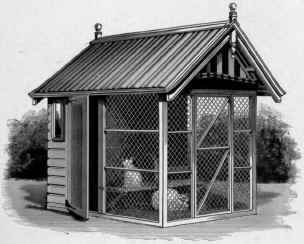
A Useful Cat House
Another illustration is a handy portable hutch, intended to be used chiefly in a house or room, although it is also convenient for penning young kittens out-of-doors on a sunny day. the wire run preventing their straying away. It consists of a sleeping-box and small wire run hooked on, and can be made at the cost of a few shillings.
The sleeping-box is 24 inches long by 17 inches wide and 22 inches high, is raised three inches from floor by a false bottom, and has a large door at back opening with a brass catch. In front, two side-pieces reduce the entry to 12 inches. A handle screwed on the top of the box is convenient for carrying. The run is 3 feet 6 inches by 24 inches-, made in four sections, two sides, top and end piece, all fitted and hooked together with 1-inch mesh wire netting that it may be easily taken apart for carrying or storing away. It makes a useful sleeping-pen, too, for young toms that are inclined to quarrel together, and so have to be shut up separately at night. All the woodwork is stained and varnished, and a square of oilcloth laid on the floor of the sleeping-box.
The next appliance to be considered is a somewhat gruesome adjunct to the cattery, and belongs to the darker side of our hobby. In spite of every care, illness and death must enter now and again, when we are fain to retire worsted from the conflict with disease, and the wisest and kindest thing to do is to put our pet to sleep. The illustration given on the opposite page depicts a lethal box, as used at the Royal London Institution for Lost and Starving Cats at Camden Town, and is capable of holding twelve animals at a time.
Mr. Ward, the well-known feline specialist of Manchester, has patented a lethal box of more moderate dimensions. Mr. Ward, not yet having an illustration of it, kindly writes me the description as follows: - "The box inside is 15 inches by 12 inches by 12 inches. A sheet of glass is inserted in the lid, so that the operator may watch the process. The vapour - coal gas passed through chloroform - enters through a tube at end. Two minutes is sufficient time." Fanciers, I think, will agree that this simple peace-giving box is not among the least of Mr. Ward's kindly ministrations to the cats he loves so well. Few amongst us can bear to see unmoved the terrible last pains of a pet who in its days of health delighted us with its beauty.
Feeding utensils we turn to next. For them nothing is more satisfactory than the unbreakable enamelled ware in white or blue - except, perhaps, for the water pans, for which it is scarcely weighty enough, and it not infrequently happens that a gay and frolicsome company of kittens will knock against them, sending them spinning, and the water is spilt upon the floor.
The circular, heavy glazed earthenware dishes, spittoon-shaped, and generally inscribed "Pussy," are excellent, and cannot be overturned.
Besides the plates and saucers for feeding, let the cats have also a saucepan of their own, a deep stewpan-shaped one, of blue enamel, large enough to cook a sheep's head with biscuits. Cook will be far less prone to grumble at the necessary cooking for the cats - I speak here of a small cattery, when no attendant is kept - if her saucepans are not pressed into the service.

A Portable Hutch
But see that all are kept scrupulously clean, nothing "left over" in the saucepan to become sour or tainted in hot weather; and after each meal is cooked, the saucepan should be boiled out with soda and scoured clean.
Earth tins. A great mistake made in these necessary items is having them too deep. I have seen an old zinc footbath supplied to two months old kittens with quite six inches of sawdust in it, and the owner wondered why she could not teach her kittens to be cleanly in their habits !
Continue to:


My Books

