


Masked Parrakeet. Psittacus personatus. P. larvatus; Pyrrhulopsis personata; Platycercus personatus
Description
This section is from the book "Parrots In Captivity", by William Thomas Greene. Also available from Amazon: Parrots in Captivity.
Masked Parrakeet. Psittacus personatus. P. larvatus; Pyrrhulopsis personata; Platycercus personatus
Psittacus personatus. Synonyms: P. larvatus; Pyrrhulopsis personata; Platycercus personatus.
French: Perroquet masqué.
German: Maskensittich.
IT is a curious fact that each group of islands in the Pacific Ocean, nay even each little isolated rock that rears its verdant head above the watery wilderness, can boast of an avifauna peculiarly its own. Not to mention the great insular continent of Australia, and the islands composing the New Zealand group, we find New Caledonia, Phillip Island, the Fiji, Samoa and Tonga Islands each possessing Parrots, or Parrakeets of its own that are not to be met with elsewhere.
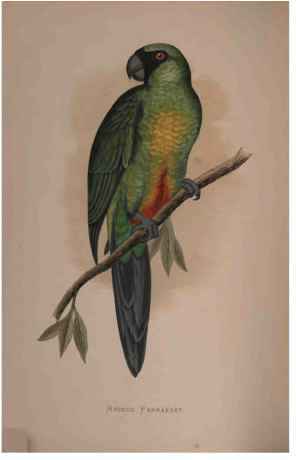
The Masked Parrakeet is a case in point: it is a native of the Fijian Archipelago, and is peculiar to it, nor does it appear to be very numerous even there. It is a strange-looking, but rather handsome bird, about the size of the King Parrot, but with a smaller head, and is very loosely feathered. The face and head are jet black, hence the specific name applied to it - "Masked"; the belly is orange, and the rest of the body green, but on the wings are numerous black and blue shades. The eyes are reddish yellow, and the legs, feet, and beak black.
Authors have bestowed upon this bird the various generic designations of Aprosmictus, Coracopsis, Platycercus, Prosopaea, Psittacus, and Pyrrhulopsis.
It is a quiet bird, seldom giving utterance to a little squeal not unlike that of Pileatus, and by no means disagreeable or distressing to the most sensitive ear. It is not particularly intelligent or interesting, and but for its handsome plumage and gentle habits is not one that we should care to keep. We have an idea, which needs to be confirmed by observation, that Pyrrhulopsis splendens, the Red Shining Parrakeet, is the female of the species under consideration; our reason being the great similarity of these birds to the Eclecti, in which subfamily the females are, contrary to the usual custom among birds, more showily attired than their male companions; and the remarkable fact that no female of P. personatus, or male of P. splendens, has yet been recorded.
It is a pity both species, if species they be, are so scarce and consequently expensive; for were they to be met with more frequently in the bird market, they would soon be much cheaper, and experiments might be made in the way of breeding them; and if success were obtained in this direction, all doubt upon the subject of their specific identity or non-identity would be set at rest.
If amateurs cannot accomplish this, surely some Zoological Society might take the matter up, and earn the thanks of naturalists, by solving a problem that will probably not be determined without their aid.
Dr. Russ quotes the price of P. personatus at from one hundred and twenty to one hundred and sixty marks - the mark being about equivalent to an English shilling - and states that "the cost of P. splendens is so high that it is only accessible to Zoological Gardens, from which, however, we have not much to hope in the way of practical experiment."
It is probable that the Amboina Parrot, described by Bechstein, is P. splendens. The old German author considered his bird to be a male, and gave the description of a supposed female; which we are unable to identify with any known variety or species. "In the female (of the Amboina Parrot) the head is green; the throat, the under part of the neck, and the breast, are the same, but having a reddish tint. The small tail coverts are dark green, edged with red; the tail itself is tinged with green. The beak is horn-brown, with a reddish tint above and below."
Either the above description refers to an immature male of Apros-mictus scapulatus, or it is that of some other species with which we are unacquainted.
P. personatus has large and broad wings, and is doubtless gifted with strong powers of flight; but the one specimen of the species we have had under observation, has, at some time or other, had one of its pinions broken, and is quite unable to fly. It is, as we have said, a quiet and silent bird, peaceable too, and not given to bite. It does not appear to be endowed with the capacity for destruction for which, some of the preceding species are so notorious, and on that account, as well as on that of its good qualities already enumerated; we can recommend it to the notice of amateurs who like to let their pets out about the room, but at the same time have a reasonable objection to seeing their furniture wrecked; as both "Pilate" and "Pinto" would wreck it, if they were not strictly watched and checked when about to indulge their mischievous propensities.
Canary seed, hemp, maize, fruit, and bread or biscuit moistened in water, will keep one of these birds in health for years. They are fairly hardy, and might, probably, be kept successfully all the year round in an out-door aviary; but upon this point the writer is without information.
Continue to:


My Books

