


Blue-Breasted Lory. Psittacus Indicus. Psittacus coccineus, Lth., Shw., Rss.; P. histrio, Mll
Description
This section is from the book "Parrots In Captivity", by William Thomas Greene. Also available from Amazon: Parrots in Captivity.
Blue-Breasted Lory. Psittacus Indicus. Psittacus coccineus, Lth., Shw., Rss.; P. histrio, Mll
Psittacus Indicus. Synonyms: Psittacus coccineus, Lth., Shw., Rss.; P. histrio, Mll.;
Eos indica, Gm., Trans. Z. S.; Lorius coccineus, Schlg.;
Domicella coccinea, Fnsch.; Psittaca indica coccinea, BRSS.
French: Perruche Lori ā diadème bleue.
German: Der Blaubrüstige Breitschwanzlori, Rss.
WHY this beautiful species should have been selected as the recipient of the specific name Indicus, or Indica, is one of those mysteries connected with the science of ornithology it is impossible to understand, for it is a native of the Moluccas; and moreover the same specific appellation had already been bestowed on the Ceylonese Hanging Parrakeet, by Kuhl.
The general colour is carmine, but there are several blue lines round the eyes, and on the sides of the neck; the breast is blue, and the saddle a somewhat darker shade of the same colour; the wings are red, with black and violet markings, especially on the shoulders; the tail is bright red, marked and spotted with deep purple and blue on the upper side, on the lower it is altogether red; and the vent is blue.
There is very little difference in the outward appearance of the sexes; seen together, the female is perhaps a very little the smaller of the two, and the colours of her plumage a trifle fainter; but these differences are not sufficiently marked to enable one to tell whether a given specimen belongs to the male, or to the female gender. The male is usually the more demonstrative and noisy, and also learns to repeat words and short phrases more distinctly than his mate; which, however, is not greatly deficient in these respects, and here again the intellectual differences are insufficient to enable one to form a decided opinion.
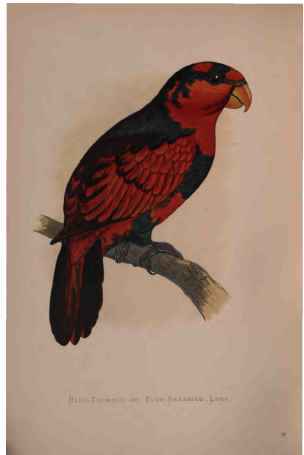
A pair, or perhaps, to speak more correctly, a couple, of these beautiful birds were added to the already rich collection of the London Zoological Society in May, 1871, and a third individual in June of the following year, but did not survive their importation very long, which is the more to be regretted that they showed themselves to be possessed of many desirable qualities, during the brief period in which they graced the Parrot House by their presence.
Dr. Meyer relates that in their native islands these Lories have always been held in great esteem as cage pets; a reputation which, he says, they deserve, "for they are never dull and sulky, like the Cockatoos, but lively, active, charming, and loveable"; and in another place he says, "they learn to speak, but never as well as the Cockatoos and Eclecti (Edelpapageien).
Herr Scheuba, on the contrary, says that they are very quiet and silent, and adds that they are very timid and easily frightened.
Although these accounts of the same bird exactly contradict each other, there is no doubt they are both taken from life; from which we may conclude that the Blue-breasted Lories, like other creatures, differ immensely in disposition, and that it is unsafe to generalize from an individual, or even from two or three.
The single specimen of this species which we have had under observation was certainly far from evincing timidity, even at the sight of a stranger, but was, on the contrary, inquisitive and forward; greeting a new comer with a series of shrill outcries, as it clung to the side of its cage which was nearest to the intruder. This bird was extremely tame, and would take food, a piece of fig, or a grape, from anyone's fingers. It was fed on rice boiled and well sweetened, also bread and milk and ripe fruit. It never seemed to ail anything; yet one morning was found dead in its cage, apparently without any cause. A postmortem examination, however, would probably have showed that a blood-vessel had given way in the brain; in consequence, no doubt, of the bird straining to relieve itself, the rice having doubtless proved to be indigestible.
Needless to remark that in their native woods these beautiful Lories, which derive their English name from a broad band of blue that extends across the breast, live principally upon the nectar of the flowers that are to be found there in such profusion, pretty well all the year round; and for which even ripe sweet fruit, figs, and especially boiled rice, form a poor substitute.
Whether it is possible to devise a better dietary, and so keep the Blue-breasted Lory in health for a more prolonged period than can at present be accomplished, or whether to allow it to range its native woods in peace, and live on the food nature has so abundantly provided for it there, are questions we must leave the intending purchaser of one of these birds to decide for himself; for even the fact of a Lory having been imported does not entirely exculpate the buyer from complicity in its premature death. If there were no demand for these birds, the dealers would soon cease to bring them over, for they are costly, and £4 or £5 too much to be risked on a chance.
Considering the rarity of these Lories in Europe, it is not surprising that no attempts have so far been made to breed them in captivity, nor is it likely, considering the brief tenure of life they appear to possess when brought among us, that success in this direction will ever be attained, at least in England. In the sunny south of France, or Italy, it is possible the birds might live, and even increase and multiply; while at the Cape, or in Australia, they would probably, in a suitably constructed aviary, "turn their thoughts to love," and a continuation of the species.
As they are mostly reared from the nest by the natives of the Moluccas, they are usually very tame when passed over to the dealers' agents; but unfortunately the greater number die on the voyage to Europe, and it is only the very few, blessed with exceptionally fine constitutions, that survive the change of climate and of food; but the very fact that some so survive, gives the dealers encouragement to persevere with their importation.
In a few instances the captive Blue-breasted Lory has been induced to eat seed, hemp, spray millet, or canary seed, and an individual of the species, in the possession of Herr Director Scheuba, partook freely of the first, to which it helped itself "regularly at eleven o'clock at night, although the room was in total darkness."
This habit, that is of taking food in the night, always indicates one of two things, either the bird is insufficiently fed, whether in regard to quantity or quality, or it is suffering from indigestion. If from the first cause, a more liberal dietary will soon cause it to abandon a custom that is not only unnatural, but very prejudicial to the bird's health; but if it is suffering from indigestion, the case becomes more serious, and must be treated on its merits; for the causes of the malady are so diverse, that no fixed rule for treatment can be laid down.
Concerning one of these birds, Dr. Meyer writes: "For a long time we had a Blue-breasted Lory, that was brought by a friend from Siao. It accompanied us to Corontalo, Makassar, and to Singapore, and afterwards to Manilla, soon after which it died. It was exceedingly tame; was very affectionate towards my wife, and liked to be near her, but was always unfriendly with me"; a differentiation of sex on the part of the bird that we have remarked in more than one instance in several kinds of Parrots and Cockatoos, the males preferring the society of ladies, and the females of men.
As might be surmised from their scarceness, the price of the Bine-breasted Lories is a high one. £4 or £5 is that demanded by the London dealers; but Dr. Russ gives from sixty-five marks for a single bird, to one hundred and twenty marks for a pair; as the figure at which they can, or could be, obtained in Berlin. In another place he says from ninety to one hundred marks each.
These birds, it is said, differ considerably in size, though as a rule one of them is about as large as the Purple-cap Lory; but Herr Scheuba mentions that he had one that was scarcely half as big. It may, possibly, have been a young one; but as it did not survive very long, this point could not be determined.
Dr. Russ gives the length of an adult specimen at from twenty-six to twenty-seven centimetres, which is a little less than the measurements given by the same author of the Purple-cap, whose length is stated to be from twenty-nine to thirty centimetres, with a length of wing of from fifteen to seventeen centimetres; but the Blue-breast has the longest tail, eleven to twelve centimetres, while that of the Purple-cap is said to be from nine to eleven. Comparing two of these birds, we have found very little difference in point of size, or as regards the length of the tail or wings; and the small-sized birds are most probably immature.
Continue to:


My Books

