


Sage Grouse
Description
This section is from the book "Bird Guide: Water Birds, Game Birds And Birds Of Prey East Of The Rockies", by Chester A. Reed. Also available from Amazon: The Bird Book.
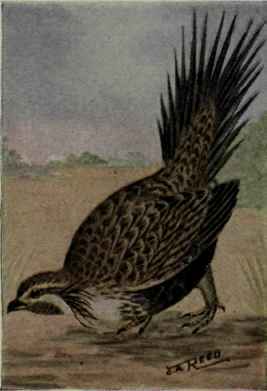
Sage Grouse
309. Centrocercus urophasittiuis. 29 in.
The female of this large and very interesting grouse, differs from the male only in its smaller size and paler, duller plumage. They are found in abundance on the dry sagebrush-covered plains about the Rocky Mts. and to the westward. In summer they feed largely upon insects and buds of various plants, but in fall and winter, their food is almost entirely the leaves of the sagebrush; at this season, in consequence, their flesh is unfit to eat, so they are not hunted for market, and are able to pursue a life of quiet as far as man is concerned. In spring, they indulge in amusing play, as do all the grouse; they have a few wiry hairs on either side of the neck, covering the naked sacs that correspond to those of the Prairie Hen; they strut about with these sacs inflated, and their spread tail, erect, making peculiar buzzing sounds.
Nest. - Eggs laid on the ground under sagebrush; greenish-buff, spotted rather sparingly with brown.
Range. - Sagebrush covered plains from New Mexico to Southern British Columbia and Assiniboia
Continue to:


My Books

