


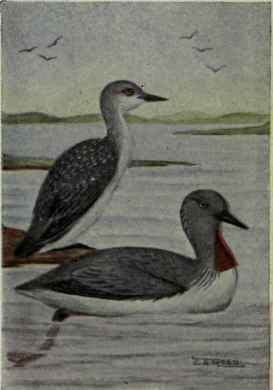
Red-Throated Loon
Description
This section is from the book "Bird Guide: Water Birds, Game Birds And Birds Of Prey East Of The Rockies", by Chester A. Reed. Also available from Amazon: The Bird Book.
Red-Throated Loon
11. Gavia stellata. 25 inches.
Besides being smaller than the common loon, this species has a more slender bill, which has a slightly up-turned appearance owing to the straight top to the upper mandible; in summer, its back and head are gray, with no white spots, although the back of the head has a few white streaks; there is a large patch of chestnut on the fore-neck; the under parts are white. In winter, it is gray above and white below, but the back is sprinkled with small white spots; at this season it can easily be distinguished from Holboell Grebe by the absence of any white patch in the wings as well as by the differently shaped feet.
Nest. - A depression in the sand or ground, not more than a foot or two from the water's edge, so they can slide from their two eggs into their natural element. The eggs, which are laid in June, are olive-brown, specked with black (2.90 x 1.75).
Range. - Breeds from New Brunswick and Manitoba north to the Arctic Ocean; winters throughout the United States.
Continue to:


My Books

