


283. Turnstone. Arenaria Interpres
Description
This section is from the book "The Bird Book", by Chester A. Reed. Also available from Amazon: The Bird Book.
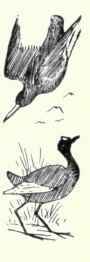
283. Turnstone. Arenaria Interpres
Range. - The distribution of this species, which is grayer above than the following, is supposed to be confined, in America, to the extreme north from Greenland to Alaska. Its habits and eggs are precisely like the next.
283a. Ruddy Turnstone. Arenaria Interpres Morinella
Range. - Breeds in the Arctic regions, and migrates through all parts of the United States, south to the southern parts of South America. This species has the upperparts variegated with reddish brown, black and white; the underparts are pure white, except for a black patch on the throat, branching upward to the eye and back to the sides of the breast. It has a peculiar, slightly up-turned bill, which is used, as their name implies, for turning over pebbles and stones in their search for food. They nest commonly in northern Labrador, about Hudson Bay and in Alaska, laying their eggs in scantily lined hollows on the ground, near water. The eggs are very peculiar and beautiful, having a light grayish or cream color ground, peculiarly marbled with many shades of brown and lilac. Size 1.65 x 1.10. Data. - Mackenzie River, Arctic America, June 28, 1900. Four eggs in a grass lined depression in the sand.

Continue to:


My Books

