


Late Summer Management And Next Year's Honey Crop. Part 5
Description
This section is from the book "How To Succeed With Bees", by E. W. Atkins and K. Hawkins. Also available from Amazon: How To Succeed With Bees: More Than 190 Successful Plans To Produce Big Crops Of Honey.
Late Summer Management And Next Year's Honey Crop. Part 5
24. If combs are to be stored in any considerable numbers, they may be fumigated to prevent destruction by wax moth larvae. Carbon bisulphide may be used with great care as it is highly inflammable when mixed with air. A spark is sufficient to cause an explosion and fire. Carbon bisulphide, when exposed to the air, evaporates rapidly and the vapor formed is heavier than air. Hive bodies of combs should be tiered tightly and evenly, one above the other, the bottom one standing on an inverted cover with several sheets of newspaper on the cover to prevent the escape of the gas. Place an empty super on top of the tier and pour the carbon bisulphide into a shallow pan in this super. Then place a hive cover on top. Leave all tightly closed for at least 12 hours, or, better still, until the combs are to be used. It is advisable to examine the combs about every 2 weeks, and repeat the fumigation during warm weather. Paradichlorobenzine, non-inflammable, may be used in place of carbon bisulphide if desired, but in rather larger proportions.
25. The table from Bulletin No. 231, of the Texas Agricultural Experiment Station, written by Professor F. B. Paddock, indicates the quantity of carbon bisulphide to be used in fumigating 10-frame bodies containing combs as follows:
Number of hive bodies in the tier | Cu. Ft. contained in tier | Amount of liquid bisulphide required |
2 | 2.90 | 2/3 ounce |
3 | 4.35 | 1 ounce |
4 | 5.80 | 11/3 ounces |
5 | 7.25 | 12/3 ounces |
6 | 8.70 | 2 ounces |
7 | 10.15 | 21/3 ounces |
8 | 11.60 | 22/3 ounces |
26. So far as protection of stored combs from mice is concerned, it is only necessary to insure that the combs are either stored in dry rooms to which mice cannot gain access, or that the hives be tiered up and closed up in such a way that the mice cannot get inside of them. The bodies of drawn combs should be tiered up so there are no cracks between the bodies big enough for the mice to get into and the pile should be closed up at the bottom and the top. You will probably find it necessary to weight down the cover that you place on the top of the pile of hive bodies to insure the safety of your combs.
27. When you figure that a drawn comb in a Hoffman frame contains 3 or 4 ounces of beeswax and it is conservatively estimated that bees may consume over a pound of honey to produce an ounce of wax, you will see these drawn combs are so valuable that they are worth every protection. The chapter on swarm control shows a surplus of drawn combs is so valuable to your success that these combs take on a value in excess of their money worth. It is a conservative estimate to value each drawn comb at at least $1.00. It is utterly senseless for any beekeeper to lose combs because of the inroads of the wax moth larvae or mice, as this can only happen through downright carelessness.
(You will receive more practical benefit from this book if you review each chapter until you can answer the questions that appear at the end of each chapter. Unless you study this book and master the principles of beekeeping your investment will not be as profitable as it should be.)
Questions You Should Be Able To Answer
1. How weak must a colony be to warrant uniting in fall?
2. Explain how to find a queen in a hive of bees?
3. How many pounds of honey are consumed from summer to summer by a strong colony of bees (food alone)?
4. Why do colonies frequently die in spring after having wintered successfully?
5. What part does the queen play in a colony?
6. Why is wind protection of so great value?
7. What happens if a colony consumes too much honey during winter?
8. How much honey is required to make a pound of wax?
9. Why does an old queen not lay many eggs in fall?
10. Why are two hive bodies desirable in winter?
11. When should bees be requeened in late summer?
12. When will feeding result in unseasonable raising of bees and prove futile for winter stores?
13. Why is sugar syrup fed to bees in fall even when they have adequate winter stores?
14. How may a queen excluder result in the death of a colony if left on over winter ?
15. Why does water condense on the roof and walls of a hive left unprotected?
16. Should honey be stored for cellar wintered bees?
17. What are the correct proportions by weight or bulk of sugar and water for feeding?
18. Which of two bodies should be placed above when wintering bees outdoors ?
19. How can you determine average winter temperatures in your locality to guide you?
20. Describe the newspaper method of uniting bees.
21. What may be used to control wax worms in combs stored in the honey house over winter?
22. Why is the beekeeper's new year not January 1 ?
23. Why is feeding in spring undesirable?
24. What is a drawn Hoffman depth comb worth?
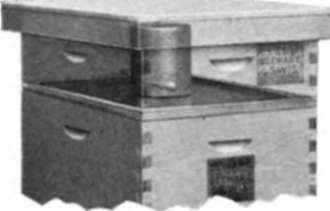
Fig. 11-A friction top pail with lid punched full of small holes inverted over a hole in inner cover with an empty super over it to make bee tight cover, an ideal feeder.
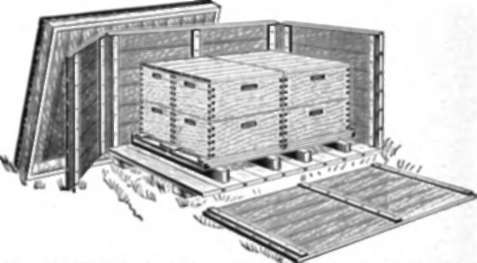
Fig. 12-The IT. S. Office of Bee Culture 4 colony case. Note each colony is in two hive bodies resting on 2x4s for under packing. A tunnel from the hive entrances to small holes in the sides of the case is provided for an outlet for the bees.
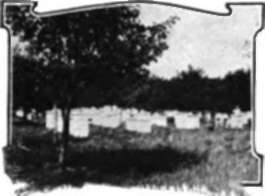
Fig. 13-A bee yard arranged to provide natural wind break all year.
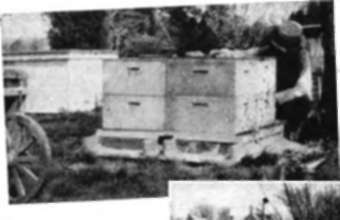
Fig. 14-In the fall the thorough beekeeper packs his hives as shown here- with cases insulated at the sides, top and bottom.
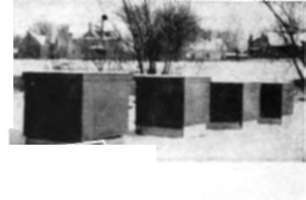
Fig. 15 - Then you know your swarms are snug and warm when zero days come.
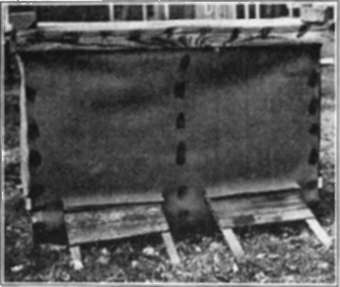
Fig. 16-The two colony case used by C. Mize, Mt. Hope, Kansas, is made with a rough frame work covered with one ply roofing composition, and packed with several inches of dry leaves.
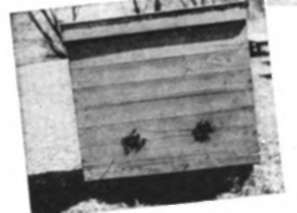
Fig. 17-And in April, when the maple is in bloom, strong, sturdy swarms are busy putting up honey for you even before they are unpacked.
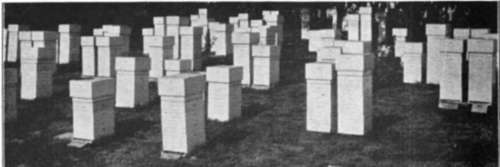
Fig. 18- E. L. Hoffmann, Janesville, Minnesota, winters his bees in the cellar. The dense wind break and telescopic covers give the bees protection after they are set out of the cellar. See the results.
Conserve Energy Of Colonies Until Spring
1. Precede winter care by correct fall management.
2. Provide wind protection for the apiary.
a. To break air currents about the hives.
b. Prevent rapid escape of heat from the hive.
c. Enable colonies to keep up temperature within hives without excess work.
.1. Pack bees before settled cold weather.
d. Determine style of packing to be used.
e. Consult U. S. Weather Bureau on average temperatures in your locality.
f. Gauge quantity of packing needed.
g. Plan packing to be kept waterproof.
4. Last minute jobs.
h. Feed any light colonies sugar syrup.
i. See that hive entrances are mouse tight.
j. Do not face more than 2 colonies the same way side by side.
5. Remember importance of 57° F.
k. Below 57° F. bees need protection, above that they fly.
1. All wintering success and spring vitality of bees depends on conserving their energy.
m. Variations in temperature in cellars more dangerous than outdoors, as bees in cellars cannot fly.
6. Keep stored combs free from attacks of wax moth larvae and mice.
n. Store combs of honey where they will not granulate, if possible.
Continue to:


My Books

