


Control Of Swarming. Part 4
Description
This section is from the book "How To Succeed With Bees", by E. W. Atkins and K. Hawkins. Also available from Amazon: How To Succeed With Bees: More Than 190 Successful Plans To Produce Big Crops Of Honey.
Control Of Swarming. Part 4
5. What procedure after swarming will usually prevent further swarming from the parent colony?
6. What becomes of field bees who return to a hive that has been placed in a new location since they left?
7. Why do old queens tend to increase swarming? What is supersedure?
8. How would you proceed to clip a queen's wings?
9. Why do we clip only the wings on one side?
10. How many wings has a queen? A worker? A drone?
11. Why does control of swarming increase the crop per colony?
12. What is the real principle back of swarm control?
13. What is the instinct that causes bees to store honey?
14. What other instinct may replace it to the detriment of the honey crop unless great care is used?
15. Aside from assistance in hiving swarms, what two other values arise from clipping queens?
16. Will a queen pass readily over capped honey? Over wood?
17. What is meant by a barrier in a hive?
18. State the principle of swarm control about which all measures center.
19. In what two ways could the queen fail to get enough egg room even though additional bodies of comb had been given?
20. Why does a colony require more storage room for nectar than is necessary for an equal amount of honey?
21. How long after a prime swarm issues will the first after swarm issue, if no control measures are taken?
22. Do bees do well unless they are allowed to swarm?
Fig. 39-Three colonies each in two hive bodies. No. 1 and No. 2 are run for comb honey. The bees are shaken out of bodies A and C in front of their respective hives. Then 1 and 2 are each given two comb honey supers. Bodies A and C placed on No. 3 to be taken care of and filled with honey.


Fig. 40-At the left is shown the arrangement of supers on colonies 1 and 2 until the honey flow ends. The third drawing shows either colony after comb honey supers have been removed and its second hive body returned to it from No. 3.

Fig. 41-How bees are shaken off the comb.
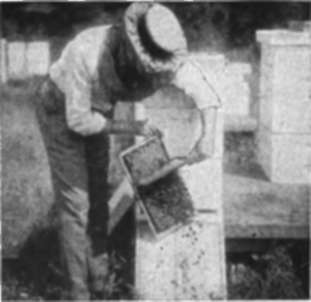
Fig. 42-Brushing bees off the comb.

Fig. 43-A comb honey producing apiary of B. F. Smith, Fromberg, Montana. Note the colony in the foreground has 9 supers on it and many others are as high.
Fig. 44-The Dr. C C. Miller queen cage is handy for caging clipped queen when her colony is swarming. Never place caged bees in the sun.

Maximum Number Of Well Filled Sections Only Obtained By Strong Colonies
1. Requirements for successful production.
a. Strong colonies of bees at beginning of honey flow and keep each colony from dividing its strength by swarming.
b. A rapid honey flow in your locality.
c. Have only honey light in color stored in sections.
2. How to produce maximum crop.
d. Colonies used should be of sufficient strength to fill two bodies previous to honey flow.
e. At honey flow use only strong colonies to produce crop of sections.
f. Bees from two hive bodies confined to one hive body and two comb honey supers.
g. Supers reversed in a few days to draw as many young bees as possible from the hive body.
h. Third super given when work well started in first two.
i. Regular examinations made at least every seven days during honey flow.
j. Study of honey plants and weather conditions to determine how rapidly supers may be given.
k. Toward end of flow bees crowded into supers to have as many sections filled as possible.
3. How to handle swarms.
1. Hive swarm on old stand.
m. Transfer supers from old hive onto new swarm hive, n. Prevent after-swarming.
o. Return all bees to hive containing swarm if no increase required.
Continue to:


My Books

