


Successful Bee-Keeping By A City Schoolgirl
Description
This section is from the book "Bees For Pleasure And Profit", by Samson G. Gordon. Also available from Amazon: Bees for pleasure and profit; a guide to the manipulation of bees, the production of honey, and the general management of the apiary..
Successful Bee-Keeping By A City Schoolgirl
Miss S. Caroline Perkins, the subject of this sketch, is a young woman whose home is on the outskirts of Waltham, Mass., and the last person one would think of as engaging in an industry; but she is a practical young woman who has taken up something that not only furnishes enjoyment and recreation but profit as well. And right here it might be well to state that if more young women of the land would interest themselves in something practical it would be well. If you will look back on the life-history of some of the leading women of this country in different fields of work you will generally find that they started early in life with some worthy work of like nature.
Bee-keeping has one great advantage over other fields of work open to women in that it is something that may be taken up at home; for, as is well said. " Home-keeping hearts are the happiest; for those who work they know not where are full of sorrow full of care."
Miss Perkins commenced bee-keeping in a very modest way when a schoolgirl of some fifteen years. Her father is a poor workingman, and she was able to invest but fifteen dollars in this first outfit.
This year she did not secure any surplus honey, but increased her stock to three colonies, which should be considered doing extra well for the first year, it being late when she commenced.
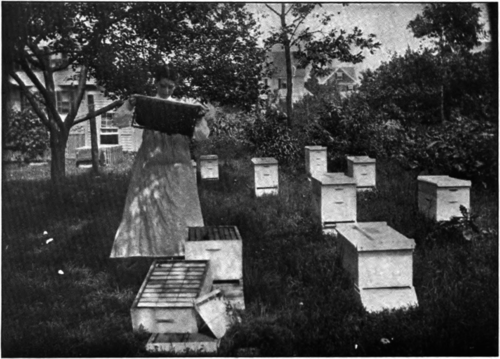
A Schoolgirl in Her Apiary.
These all wintered well, and during the second summer she increased them to five colonies and made about $5.00 worth of honey, or a total profit of over fifteen dollars for the second year of a schoolgirl's bee-keeping.
In the third year she sold 125 pounds of honey at 25 cents a pound, and one colony of bees, or a total of $35.00.
The fourth year she sold 220 pounds of honey and 7 colonies of bees, making a total profit of about one hundred dollars.
This may be considered a remarkable record when it is taken into consideration that all these colonies were increased from the original one, and that in a city, by one busy with schoolwork, and with no other help than that of a younger brother who helped to sell the honey. Besides attending to these she earned quite a little money attending to other people's bees. She raises her own queens, and works entirely for comb honey. She is a member of the Massachusetts Apicultural Society.
As to methods, quoting her own words, she says, " I believe in stimulating the bees in the spring so that, when the honey-flow begins, they will be all ready for work in the supers. I find they start sooner in the section boxes if I put an extracting-super on first; and as soon as they are started in this I put a comb-honey super under it, and they go to work at once in that super. We have two flows of honey-one of clover and one of goldenrod." That she is practical, and handles her bees with the skill of an expert, one can testify who has seen her handle them or talked with her on the subject.
I think this record will show that she is doing better than many older bee-keepers. We predict a brilliant future for this girl when she can leave her studies and devote her whole time to bee-keeping. We believe she will be one of the leading women bee-keepers of the nation. She is now away from home attending the Farmingham Normal School. Two hundred dollars would be quite a lift to many boys and girls who are working their way through school or college, and I hope many others will read this article and go and do likewise.
Continue to:


My Books

