


Rise Of Commercial Queen Raising. Part 2
Description
This section is from the book "History Of American Beekeeping", by Frank Chapman Pellett. Also available from Amazon: History Of American Beekeeping.
Rise Of Commercial Queen Raising. Part 2
The object, he stated, was to secure good queens which could be sold at a dollar each. To those who would offer such queens at this price, he offered to insert a card in Gleanings free. He also described the method, later commonly used, of establishing nuclei for the care of young queens until they were laying and ready to be shipped to fill orders.
It was not long after that reports of dissatisfaction on the part of purchasers of queens from advertisers began to creep into the magazine in the form of letters from readers. As is likely to be the case with any new undertaking, there were many difficulties to be met and many of the complaints were without proper foundation. Yet, in many cases the buyer never received anything for his money.
Although reporting failure when eggs were sent for long distance by mail, Root apparently continued to supply them on demand. Later we find in his magazine references to the removal of the larvae in natural-built queen cells and their replacement with larvae hatched from such eggs. The first reference to "grafting" is by E. C. L. Larch, who uses the word to indicate such a change. Apparently his idea was good, since the word later came into common use in connection with the transfer of larvae to artificial cups.
A man named W. L. Boyd seems to have been the first to suggest cups on the order of those afterwards developed by Doolittle, but he failed to appreciate his own discovery. In October, 1878, he wrote to Gleanings to suggest cutting out the acorns or rudimentary queen cells always to be found in every hive. He pointed out that one could thus have plenty of queen cells on hand and that, by taking a flat stick and transferring a newly hatched larva to the acorn, the bees would care for it and soon a nice sealed cell would be available. Root, as usual, appreciated the suggestion, and carried it further by outlining how artificial cells could be made by dipping a wet stick in melted wax. He even went so far as to publish a picture showing how these cells could be spaced along the strip of wood ready for use, and offered to sell them for ten cents per dozen by mail.
In view of later developments, it seems surprising that nothing came of this suggestion. Here was the modern system of queen rearing all but complete. Together, editor and correspondent had outlined it from the dipping of the cells to the transfer of the larvae, yet it appears that no one took any notice nor did they follow up the proposal to put it into use. How often does history thus repeat itself, with discoveries unappreciated and left for others to bring forward again at a later time. Root stated, however, that the idea had been suggested previously by someone else whose name he failed to disclose. One cannot but wonder whether this furnished Doolittle with the idea which he capitalized so successfully a few years later.
In 1880, O. H. Townsend, of Michigan, described in Gleanings his method of queen rearing by fastening strips of new comb containing eggs in position with cells opening downward. To start with, he placed a clean white worker comb between two combs of brood in the hive containing his breeding queen. When this was filled with eggs, he was ready to start operations. From a strong colony he removed the queen, with two frames of brood and bees, to a new location. He then removed the rest of the frames containing brood by shaking the bees from them, and replaced the brood frames with empty combs. The new comb of eggs first mentioned was now cut into strips, and one strip was attached near the top of each of four or five of the empty combs and replaced in the hive. The bees finding themselves queenless and broodless would utilize this new material by building numerous cells.
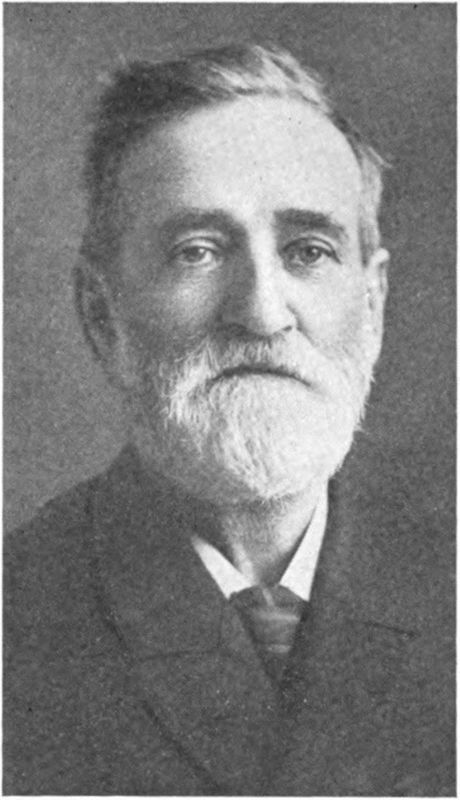
Henry Alley, who originated the first successful system of commercial queen rearing.
It remained for J. M. Brooks, of Indiana, to propose an even better method of shaving down the comb nearly to the midrib and fastening strips to wood bars to be hung in a frame. He appears to have been the first to use cell bars for support of his embryo queens. The picture with his letter, in the August, 1880, Gleanings, shows a frame with three such bars, each filled with cells. The editor adds a footnote to the effect that his neighbor, Clark, raises cells for him on a somewhat similar plan.
Thus was the way prepared for the development of the first system of queen rearing published by Henry Alley, in 1883. At that time the lamp nursery was used by queen breeders who attempted to obtain a considerable number of queens. This nursery is described as a hive made of tin with double walls. The space between the walls, from one-half to one inch, was filled with water which was maintained at a temperature of about 100 degrees by means of an oil lamp underneath. Frames containing ripe cells were hung in this nursery and required very careful watching on the part of the beekeeper.
Continue to:


My Books

