


Chapter IV. The Hive Controversy
Description
This section is from the book "History Of American Beekeeping", by Frank Chapman Pellett. Also available from Amazon: History Of American Beekeeping.
Chapter IV. The Hive Controversy
The controversy over the size and shape of bee hives began very soon after Langstroth's invention was offered to the public and lasted for more than half a century. At its height most of the leaders of the industry joined in the discussion, and the pages of the bee magazines contain many bitter arguments.
Soon after his arrival in this country, Charles Dadant began a long series of experiments in which he made use of every kind of hive which claimed public attention. He wrote hundreds of articles for European bee magazines in an attempt to win favor for the movable frame which was coming into popularity in America, while much of his writing for bee papers in this country was aimed at the small hives so generally advocated. He had not been here long when he was visited by an Iowa beekeeper who had heard of him. His visitor was struck by the great variety of hives and suggested that to use only one kind would be more profitable. Dadant replied that one kind would be more profitable, but he could not yet decide which ones to discard.
Dadant quickly recognized the defect of small hives and in 1868 called attention in the American Bee Journal to the worst drawback to the Langstroth hive. He said that queens do not lay as many eggs in shallow as in square hives, and that in shallow frames the bees draw out the cells in the upper part of the comb to unusual depth in an attempt to put more honey above the brood nest. This widening of the combs added to the difficulty in removing the combs from the hive.
In 1870, he wrote to the Journal des Fermes in France to tell of a visit to a neighbor where he saw bees building traces of comb on the outside of large hives because of a crowded condition of the colonies, while those in small hives had scarcely filled their supers. He suddenly realized the significance of this condition. The bees in the large hive were crowded because there had been plenty of room for the queen to lay and for the colony to produce a large population, while in the small hive increase had been slow for lack of room.
Returning home, he at once constructed some hives with sixteen frames in place of eight. He reported the result as miraculous. From that time forward he was a consistent advocate of large brood chambers.
In a hive containing many small frames, the same surface of brood needs more bees to encircle it, than in a hive whose frames are larger. By actual count, I have found that a square frame 12 inches both ways, needs 15 percent more bees to encircle the same amount of brood than in a Quinby hive whose frames are larger, being 18 inches long by 11 inches in height.
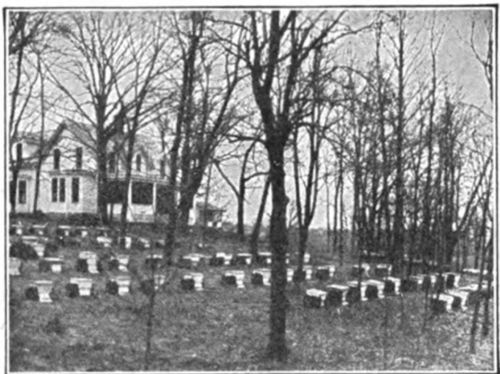
Home and apiary where bees have been kept by four generations of the Dadant family.
In 1875, in the American Bee Journal, he called attention to the fundamental fact that more bees are required to encircle the brood in hives with smaller frames than with larger ones, as follows:
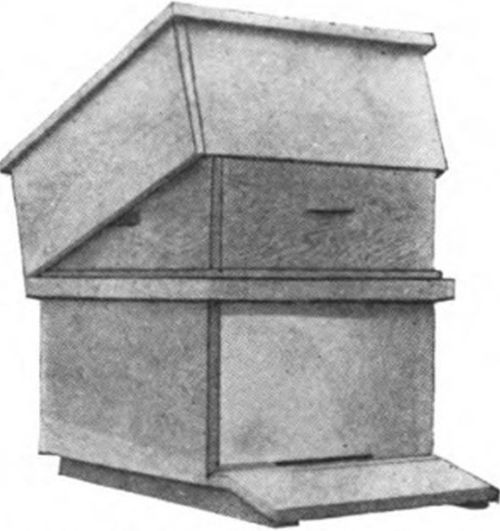
Large hive as developed by Charles Dadant.
The comb honey section was just then coming into use, and the beemen were more intent on getting nicely finished sections than on the fundamentals of their craft. In 1883 and '84, G. M.
Doolittle began writing about a six-frame hive which he used.
He used a hive containing nine Gallup frames which were eleven and one-fourth inches square.
In order to secure the most honey from his colonies Doolittle further reduced the combs to six.
He thought that by reducing the necessity for normal activity to the lowest point, more bees would be released for field work with a larger crop of honey as a result. He stated that when he first tried this plan he feared that six combs would not hold enough honey for winter but found that it had a tendency to reduce the brood so that he had from eighteen to twenty-two pounds of honey in the frames in September, with a very small colony of bees for wintering.
Continue to:


My Books

