


Spring Management Of The Overwintered Colony. Early Spring Management. Part 4
Description
This section is from the book "Beekeeping for Beginners", by G. H. Cale, Jr.. Also available from Amazon: Beekeeping for Beginners.
Spring Management Of The Overwintered Colony. Early Spring Management. Part 4
The production of extracted honey means some added expense for equipment that would not be justified with two colonies but which is more than justified by the amount of honey produced from ten or more colonies. The only additional expense that need be considered for the first few years is the cost of an extractor and uncapping knife.
In extracting the honey from the combs, the first step is to remove the layer of wax over the top of the cells, called "cappings. " This is accomplished by means of an uncapping knife. The knife slices the wax seal from the cells so that the honey may be thrown out by centrifugal force in an extractor.
There are a number of different kinds of uncapping knives, ranging in price from a few dollars on up to as high as twenty dollars. Most beginners start out with a type of uncapping knife that may be used cold-that is, it is not heated by either steam or electricity. However, a warm knife works to better advantage. With the cold type of uncapping knife, it is best to have two knives available-keeping one in a pan of boiling water while the other is in use, exchanging knives for each frame to be uncapped, much on the same principle as the flatiron which is heated on a wood or coal-burning range. For complete ease and speed in uncapping combs of honey, the beginner will find the electric knife desirable, as after hooking into the electrical circuit and warmed, the knife may be used continuously without waiting for a warm-up between combs. The hot knife slices through the cappings with a speed that is amazing.
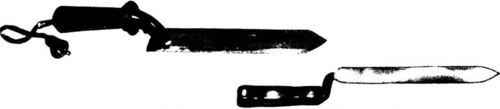
Top - electric knife Right - cold knife
The cappings from the comb may be caught in a wash tub, or some similar metal container. A good practice is to take an old wash tub and cut out the bottom, replacing it with wire hardware cloth fastened to the sides of the tub with rivets or bolts. Then place the tub on a wooden frame and place a large metal tray under the hardware cloth. If the cappings are caught in a container such as this you will find that considerable honey will drain down through the cappings and accumulate in the tray below. A wooden paddle or board may be used to stir and break up the cappings so that more honey will drain from them. This honey may then be added to that which comes from the extractor. Always remember to save your wax. The wax which comes from cappings is a light lemon color and commands the best price of any wax on the market. To obtain the most money for your wax you should separate it from the honey by placing the cappings in a large tub of hot water after you have first drained or squeezed all possible honey from the fresh cappings-allowing it to cool after the wax has all melted. The solidified wax may then be removed from the top of the water. Send the wax, properly labeled with your name and address, to your bee supply dealer. You will be amazed at the amount of money your beeswax will bring.
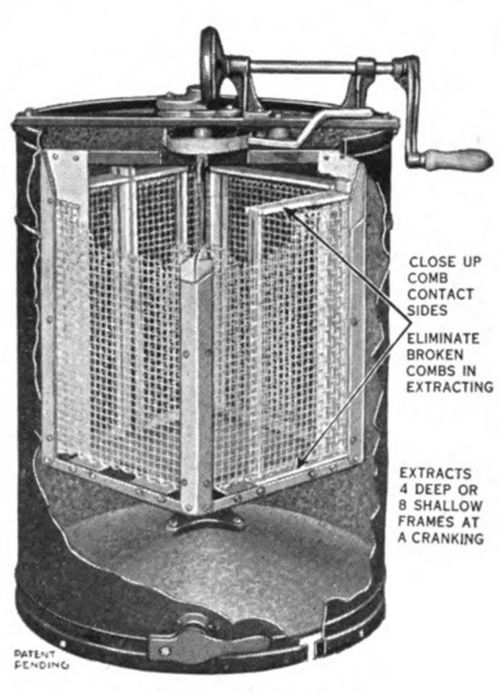
Honey Extractor
There are a number of different extractors available ranging in price from about twenty-five dollars up to four hundred dollars. One of the smaller extractors, run by hand, will easily take care of the production from twenty colonies. The beekeeper with a mechanical aptitude may readily take a small hand extractor and convert it into an electrical powered extractor by the addition of an electric motor, belt and pulley. After the honey is extracted, it may be drawn from the extractor into sixty-pound cans. When the complete crop is extracted, the inside parts of the extractor may be removed, a filter made of various meshes of hardware cloth and bolting cloth placed on top of the extractor, and the honey poured through the filter back into the extractor. In this manner, the extractor may be used for a settling tank, allowing the honey to stand for twenty-four hours to allow it to clear before drawing it off into pails, jars, or other containers for use or for sale.
Continue to:


My Books

